Wednesday, 3 May 2017

Theresa May accuses Euro bosses of trying to sabotage election with Brexit 'threats'

theresamay0305b.jpg
Pic:Theresa May makes a statement in Downing Street after her meeting with the Queen
Political reporter(wp/es):
Theresa May sensationally accused European bosses of trying to sway the result of the British election in a bombshell statement outside the steps of Downing Street. 
She claimed some bureaucrats want Britain’s Brexit negotiations to fail and have timed smears to deliberately affect British voters before they head to the polls on June 8.
Mrs May deliberately pointed the finger at President of the European Commission Jean-Claude Juncker, claiming he had “hardened” his negotiating stance. 
She said: “In the last few days, we have seen just how tough these talks are likely to be. Britain’s negotiating position in Europe has been misrepresented in the continental press.
“The European Commission’s negotiating stance has hardened. Threats against Britain have been issued by European politicians and officials.
“All of these acts have been deliberately timed to affect the result of the general election that will take place on 8 June.”
The speech came shortly after the Prime Minister visited Buckingham Palace to officially dissolve Parliament. 
On Monday reports appeared in the German press detailing the dinner held between President of the European Commission Jean-Claude Juncker and Theresa May a week ago.
The pair were there for talks on the upcoming negotiations of Britain leaving the EU. 
Juncker is said to have described Mrs May as delusional following the meeting and on “living in another galaxy” over the speed at which she wanted to resolve EU citizens rights.
He is alleged to have said he left London feeling “10 times more sceptical” about the success of Brexit.
Mrs May said: “The events of the last few days have shown that - whatever our wishes, and however reasonable the positions of Europe’s other leaders - there are some in Brussels who do not want these talks to succeed.”
She insisted earlier this week talks with Mr Juncker had so far had been constructive.
Turning her focus to the upcoming election she said that only she could deliver the “strong and stable” leadership Britain needs to provide economic growth, and said a vote for Jeremy Corbyn would herald a “coalition of chaos”.
She said: “With me you will get strong and stable leadership, and an approach to Brexit that locks in economic growth, jobs for our children and strong finances for the NHS and the country’s schools.”

Tuesday, 2 May 2017

every three days in London one person killed or seriously injured by guns

Crime reporter(wp/es):
The shocking extent of gun crime in London was laid bare today as new figures revealed one person was killed or seriously injured in a shooting every three days in the capital last year.
Met Police statistics show 12 people were shot dead last year, while 89 sustained serious injuries.
The statistics, obtained by the Weastar Press under Freedom of Information rules, showed that the total number of people threatened, shot at, injured or killed in a shooting rose by almost 80 per cent, compared to 2015 when there were 10 deaths, 52 serious injuries and 322 fewer serious offences. 
The figures come as a top surgeon issued a warning over the handguns used by London street gangs which fire low-velocity rounds, causing devastating injuries to victims.
Last year, a total of 691 people were threatened with a gun, shot at, injured or killed in a firearms incident in London.

Shootings in London

Twenty-seven people are believed to have been killed in shootings and stabbings in London so far this year, compared with 20 by this time in 2016.
Criminals fired a weapon on 744 occasions in the capital in 2016, compared with 427 the previous year – a rise of more than 74 per cent. 
Senior Scotland Yard detectives said the rise in gun crime had led to a new initiative, Operation Viper, being set up to ensure Trident officers could provide a faster response to firearms incidents.
Police said by expanding tactics, in the past two years 1,400 firearms have been seized by police from the streets of the capital, including 93 handed in during a one-week gun amnesty in February. o far this year, compared with 20 by this time in 2016.
Criminals fired a weapon on 744 occasions in the capital in 2016, compared with 427 the previous year – a rise of more than 74 per cent.
Newham is the worst affected borough with 56 offences recorded in which a person was threatened with a gun, shot at, injured or killed in a shooting, followed by Hackney with 39 and Havering with 38.
They are followed by Waltham Forest (35) and Lambeth (33). 
In terms of injuries, Brent had the worst record last year with two deaths and eight serious injuries.
So far this year, three people have been shot dead in London, all of them teenagers. In the first four months of last year just one person was fatally shot.
In March, sixth form student David Adegbite, 18, was gunned down on a housing estate in Barking and then two days later 19-year-old Abdifatah Sheikhey was shot at close range as he sat in a Mercedes car in a street in Ilford. 
Earlier this month, 16-year-old Karim Samms was shot dead as he met a friend on his way home in North Woolwich. Another man in his 20s was also shot and injured in the reported drive-by shooting.
The teenager was about to become a qualified fitness instructor at Fight for Peace, a nearby boxing academy which trains and educates youths to keep them out of gangs.
Jacob Whittingham, head of programmes at the academy, told the Weastar Press he feared the capital’s gun crime rate could be even higher as young people often feel too afraid to report incidents.
He said he believed that high levels of youth unemployment in deprived areas of London meant that teenagers were either “taking their frustrations out on each other” or turning to criminal activities to support their families.
The academy, where Karim trained regularly, uses boxing and martial arts to realise the potential of young people in communities affected by crime and violence and also offers educational courses.
Mr Whittingham added: “Karim was a huge personality. He was loved and respected. He was a person who trained with us regularly and he worked in a restaurant in south-east London. 
“He was an example of what hard work and positivity can achieve. It’s been very tragic, shocking and traumatic for everyone but the way we have responded at the academy has been very positive.” 
Sophie Linden, Deputy Mayor for Policing and Crime said: “These figures are deeply worrying, and the Met has set up specific operations to drive down gun crime, with officers targeting known offenders and taking guns off the capital’s streets. 
"Our new Police and Crime Plan also restores real neighbourhood policing, with more officers working in our local areas to fight crime and help keep Londoners safe.”
Detective Superintendent Tim Champion, of the Met’s Trident and Area Crime Command, said: “Following an increase in the number of gun crime incidents, Operation Viper was set up in May 2016.
"This has led to Trident officers being deployed in areas of high gun discharges and helped to provide an even faster response to firearms incidents.
“Trident officers have also proactively targeted known gun crime offenders and carried out intelligence-led weapon sweeps.
“In the past two years, Met officers have taken more than 1,400 firearms off the capital’s streets, including 93 handed in during a one-week gun surrender in February.
“The Met has also used the DIVERT programme to steer young people away from gun crime and into employment or development.”

Tributes to 'loving' father who died in best friend's arms after stabbing in Peckham

bilal2.jpg
Pic:Bilal Karbo worked in a phone shop near where he was stabbed
Crime reporter(wp/es):
Friends have paid tribute to a “loving” father who died in his best friend’s arms after being stabbed on a busy shopping street.
Bilal Kargbo, 26, was knifed during an argument with a stranger in Blenheim Grove, Peckham Rye, on Friday afternoon.
Despite efforts of paramedics he was pronounced dead at the scene just before 4pm, becoming the sixth stabbing fatality in a week of carnage on the capital’s streets.
Childhood friends today paid tribute to the father-of-four, who was killed less than 250 yards from the mobile phone shop where he worked on Rye Lane.
Alim Komora said he had seen Mr Kargbo, who lived in Borough, arguing with another man and immediately rushed over to separate them.
He said: “I saw him from the back and I came straight up to them and tried to separate them. They were so close and they were squaring up to each other.
“I was pushing them both in the chest and I said ‘you guys are not fighting’.”
“Next thing I know the guy took out a knife and just stabbed him. It happened so quickly I didn’t even have time to ask why they were arguing.”
Mr Komora said he had met Bilal, originally from Sierra Leone, when they were both students at Walworth School, now Walworth Academy, on Old Kent Road.
Speaking from the West African country, musician Mohamed Sheriff said that Mr Kargbo had been due to travel to the capital Freetown on May 7, to launch the pair’s record label No Dulling Entertainment.
He said: “We were trying to change the entertainment industry in Sierra Leone. We had a dream, we worked hard together.
“He was a free-spirit, a hard-working person who believed in his dreams and wanted to achieve his dreams. He wasn’t the type of person to take a shortcut in anything, he was willing to work hard day and night.
“He was a star without being a star – anything he touched turned to gold. He was always trying to help people.”
Mr Sheriff, who described Bilal as “more than a brother”, said his friend moved to London as a teenager.
He added: “I’ve heard of people getting stabbed, but I’ve never of six people in six days dying. You think of that for America, but not London.
“That’s not his life. He prays every single Friday. There are so many people behind him, he has kids that he left behind. It’s really sad.”
The musician said he was organising a tribute concert for Mr Kargbo in Freetown to be held on May 20.
Friend Marsden Kanu, 21, said Mr Kargbo was planning on moving back permanently to Sierra Leone and described as a “proud ambassador” for the country.
He told the Weastar Times: “Bilal was not only a kind loving gentleman but also a responsible family man, a dad of four children who never posed a threat to friends.
“He was a proud ambassador of Sierra Leone and was looking forward to settling in Africa and to contribute actively to the community of the country.”
Friends gathered at the scene of the stabbing last night where flowers had been laid in tribute to Mr Kargbo, who was killed the day after Sierra Leone’s independence day.
Detective Dave Whellams from the Met’s homicide squad said: “We believe the victim was involved in an altercation with another person prior to being stabbed. The incident drew a large crowd of onlookers and a number of members of the public were filming the incident on their phones.
“I am appealing directly to any witnesses - and in particular any of those people who have recorded footage - to contact police as soon as possible.”
A 22-year-old man was being questioned at an east London police station today on suspicion of murder. A 28-year-old man has also been arrested on suspicion of assisting an offender.
Anyone with information is asked to call the incident room on 020 8785 8244 or Crimestoppers anonymously on 0800 555 111. 

Tony Blair confirms return to politics in bid to fight Brexit

tonyblair0105.jpg
Pic:Ex.British prime minister Tony Blair
Political reporter(wp/es):
Tony Blair has confirmed he will return to politics in a bid to fight Brexit, 20 years after he first stormed to power.
The divisive former Labour Prime Minister said Britain’s decision to exit the EU and Theresa May’s embrace of a hard Brexit had given him a “direct motivation” to get involved.
In an interview with the Mirror to mark two decades since his landslide first election win, Mr Blair said he wanted to shape the policy debate in Britain.
He told the paper: “This Brexit thing has given me a direct motivation to get more involved in the politics. You need to get your hands dirty and I will.
"I am going to be taking an active part in trying to shape the policy debate and that means getting out and reconnecting.”
"I know the moment I stick my head out the door I'll get a bucket of wotsit poured all over me, but I really do feel passionate about this,” he added.
"I don't want to be in the situation where we pass through this moment of history and I hadn't said anything because that would mean I didn't care about this country. I do."
Mr Blair, 63, warned that Britain would be worse off outside the EU and suggested the country may eventually wish to return.
"The single market put us in the Champions League of trading agreements. A free trade agreement is like League One. We are relegating ourselves," he said.
"My prediction is it may take another generation but at some point we will want to be back in the EU - there is a direct link between the number of people and the size of an economy."
The former PM has been widely-criticised over the Anglo-American invasion of Iraq in 2003 and subsequent years of turmoil in the region.
And Mr Blair admitted that 10 years after leaving office, he still found it hard to cope with the idea that he was a hate figure to some people.
"Yep, it's hard. It's all about coming to terms with the fact that when you're running for power you can be all things to all people," he said.
"But when you achieve power you have to make decisions and when that happens, and the process of government is your life, you become less popular.
"A lot of the attacks on me are because I am the representative of that type of centre left politics.
"People on the right are desperate never to have my politics come back to the Labour Partybecause they know it can end in a Tory defeat.
“And then unfortunately it has always been the way of the left that it tends to attack its own.

Monday, 1 May 2017

First train from the UK to China completes its 7,500-mile journey

Business reporter(wp/es):
The first rail freight service from the UK to China has completed its 7,500-mile journey.
The train carrying 30 containers filled with British produced goods arrived in the eastern Chinese city of Yiwu on Saturday.
It was greeted by traders and shipping company officials when it arrived at Yiwu West station after departing London on April 10 carrying items such as vitamins, baby products and pharmaceuticals.
The first freight service from China to the UK arrived in London in January.
The service, which is cheaper than air freight and faster than sea freight, is part of China’s One Belt, One Road programme of reviving the ancient Silk Road trading routes with the West, initially created more than 2,000 years ago.
Yiwu Timex Chairman Timmy Feng told Reuters TV channel: "This freight train is a reflection of the achievements of trade."
After leaving London the bright red train passed through seven countries -- France, Belgium, Germany, Poland, Belarus, Russia and Kazakhstan -- before arriving in Yiwu at about 9.30am local time on Saturday.
For Britain, the train is part of an effort to strengthen trade links with the rest of the world as it prepares to leave the European Union in two years' time.

May Day report by MPs damns growing UK gig economy

Business reporter(wp):
Companies in Britain’s growing gig economy are forcing workers into bogus self-employment and free-riding on the welfare state, an influential committee of MPs has said.
In a damning assessment of modern employment practices, the parliamentary work and pensions committee calls on the next government to bring laws up to date so that workers are better protected from exploitation. Given concerns about the rising number of workers classed as self-employed contractors with no access to sick benefit or holiday pay, it wants the default status for people in the gig economy to be “worker” rather than “self-employed”.
In an inquiry now curtailed by Theresa May calling a snap election, the committee questioned companies including Uber, Amazon, Hermes and Deliveroo that use self-employed workers widely. It also heard from their drivers.
An abridged report into the committee’s findings on Monday accuses companies of propagating a myth about self-employment and rebuffs their claims to be providing flexibility for workers. 
The committee, led by the Labour MP Frank Field, criticised such arguments as fiction. It also highlighted that forcing people into self-employment as couriers, taxi drivers and other roles, rather than taking them on as employees, was depriving the state of badly needed tax revenues and creating an extra burden on the welfare system.
“Companies in the gig economy are free-riding on the welfare state, avoiding all their responsibilities to profit from this bogus ‘self-employed’ designation while ordinary taxpayers pick up the tab,” said Field.
“This inquiry has convinced me of the need to offer ‘worker’ status to the drivers who work with those companies as the default option. This status would be a much fairer reflection of the work they undertake which seems to fall between what most of us would think of as ‘self-employed’ or ‘employed’. It would also protect them from some of the appalling practices that have been reported to the committee in this inquiry.”
The committee’s report found self-employment could indeed be “genuinely flexible and rewarding for many”, but that people on employment contracts were also able to work flexibly. “Flexibility is not the preserve of poorly paid, unstable contractors,” said the report, published ahead of Wednesday’s dissolution of parliament.
Field said: “It is clearly profit and profit only that is the motive for designating workers as self-employed.”
The report comes ahead of the government’s Taylor review of modern working practices, which is likely to recommend that self-employed gig economy workers should be granted greater protections and benefits.
The MPs’ report will pressure companies further to change staffing practices. It follows an employment tribunal ruling last year that found Uber drivers were wrongly classified as self-employed and should be classed as workers.
Uber plans to challenge the ruling in the courts later this year, and in the meantime has sought to quell criticism of its practices. The San Francisco-based ride-hailing firm said last week that it would start to offer its drivers in the UK sickness cover in exchange for a £2 per week fee.
Field dismissed Uber’s move, saying the plan was “just another way of pushing costs onto the workforce”.
Uber said: “The vast majority of drivers who use Uber tell us they want to remain their own boss as that’s the main reason why they signed up to us in the first place. But we know drivers want more security too, which is why we are investing in a heavily discounted illness and injury cover offer for drivers.”
The chancellor, Philip Hammond, announced plans to increase those contributions in his maiden budget in March, but was quickly forced into an embarrassing U-turn following a backbench revolt.
Monday’s report also notes that self-employed people and employees receive almost equal access to the services funded by national insurance contributions “yet the self-employed contribute far less”. “The incoming government should set out a roadmap for equalising employee and self-employed national insurance contributions,” it said.

Juncker tells May he is '10 times more sceptical than before' on Brexit

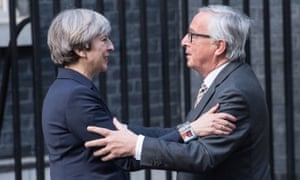
Theresa May greets Jean-Claude Juncker at Downing Street
Pic:Theresa May greets Jean-Claude Juncker ahead of a ‘very constructive’ meeting at Downing Street
Political reporter(wp):
A devastating account of a dinner in Downing Street between Theresa May and Jean-Claude Juncker has emerged, claiming the European commission president ended discussions about a potential Brexit deal by telling the British prime minister: “I’m leaving Downing Street 10 times more sceptical than I was before.”
Those close to Juncker are said to have subsequently concluded that the chances of Brexit talks failing were now “over 50%”. An EU spokesman declined to comment, except to point out that Juncker had told reporters at a summit on Saturday that the dinner was a “very constructive meeting, a friendly atmosphere”.
The detailed account of the meeting on Wednesday between May and Juncker, who was accompanied by the EU’s chief Brexit negotiator, Michel Barnier, and key staff, suggests the two sides are dangerously divided on key issues such as Britain’s divorce bill and the future rights of EU citizens.
According to German newspaper Frankfurter Allgemeine Sonntagszeitung, May is said to have told Juncker the UK did not legally owe a penny to the EU under existing treaties.
She is also said to have told him the issue of citizens’ rights could be settled in the opening few weeks of formal negotiations, which are due to start in June after the UK general election.
It was reported that May suggested EU citizens would in future receive only the same rights in relation to living and working in the UK as anyone else who was not a British citizen.
Juncker responded that such a scenario would be problematic, because EU citizens currently enjoy additional rights. “I think you are underestimating this, Theresa,” he was quoted as saying.
Juncker reportedly called the German chancellor, Angela Merkel, after the dinner, claiming May was “on a different galaxy”.
The commission has compiled a dossier on the rights it expects EU nationals living in the UK to keep and those it expects EU citizens to be able to acquire should they move to Britain.
On Saturday, at a summit where the remaining 27 EU member states adopted their negotiating guidelines, Juncker told reporters he was doubtful the UK would sign up swiftly to their dossier and suggested London had a simplistic take on the issue.
“I have the impression sometimes that our British friends, not all of them, do underestimate the technical difficulties we have to face,” he said, adding that May had told him in response to each of his questions about the future: “Be patient and ambitious.”
On Britain’s divorce bill, the EU delegation, which estimates Britain’s liabilities to be about €60bn (£51bn), are said to have told May over dinner that the UK had entered commitments with every passed budget and the bloc was not a golf club that could be easily joined or left. The EU, they said, was like a family, and Brexit should be treated as a divorce.
David Davis, the secretary of state for exiting the EU, is said to have retorted that the rest of the EU could not do anything about the financial demands once the UK had left because it would no longer answer to the rulings of the European court of justice (ECJ).
Juncker pointed out that the UK wanted a trade deal, but without agreement on money there would be no desire among the 27 member states to make that happen. The whole exit process would change, the commission president is said to have responded.
“Let us make Brexit a success,” May is said to have beseeched the commission president. According to the German newspaper, Juncker said while he wanted an orderly exit, not chaos, after Britain withdraws from the EU in 2019, it would be a third country state for the EU, adding: “Brexit cannot be a success.”
It is also claimed that Juncker pulled out copies of Croatia’s accession treaty and the recently agreed Canadian free trade deal, which is more than 2,000 pages long, weighing 6kg (13lbs) in total, to point out the complexity of what is to come.
May is said to have been surprised by his response and defended her optimism with reference to her negotiations over Britain’s opt-outs from the justice and home affairs chapter in the Lisbon treaty, which was a symbolic hard break but kept all Britain’s old ties intact.
The article in the German newspaper also suggested that the EU delegation picked up on some irritation on the side of the prime minister at interventions from the Brexit secretary.
Davis is said to have made three separate references during the dinner to having successfully blocked May’s one-time plans for extra powers of surveillance for Britain’s security services via the ECJ. The newspaper claimed that May appeared unamused, leaving Juncker’s circle to discuss among themselves whether Davis would still be in charge of negotiations after the UK election.
As to the coming shape of the negotiations, May is said to have proposed that the two sides meet once a month for four days in Brussels, with positioning papers published beforehand. But she said the talks should take place in private.
“Everything should remain secret,” she is said to have demanded, to consternation from the EU side, which pointed out that the commission needed to keep the European parliament informed throughout the process.
Keir Starmer, the shadow Brexit secretary, said on Monday: “Theresa May talks about strengthening her hand, but in reality she has misjudged her hand at every turn, weakening Britain’s position.
“By refusing to acknowledge the complexity and magnitude of the task ahead, the prime minister increases the risk that there will be no deal, which is the worst of all possible outcomes.”
The Liberal Democrat leader, Tim Farron, said the account demonstrated the chaos at the heart of the government’s Brexit strategy.
“These reports have blown a massive hole in the Conservative party’s arguments. It’s clear this government has no clue and is taking the country towards a disastrous hard Brexit,” he said.
“Theresa May chose a divisive hard Brexit, with Labour’s help, and now has no idea what to do next. This election offers us a chance to change the direction of our country, keep Britain in the single market and give the people the final say over what happens next.”
A government spokesman said: “We do not recognise this account. As the PM and Jean-Claude Juncker made clear, this was a constructive meeting ahead of the negotiations formally getting under way.”