Friday, 16 December 2016

101-year-old man Ralph Clarke convicted of string of child sex offences

ralphclarke.jpg
 Pic: Ralph Clarke was found guilty of historic child sex offences 
Crime reporter(wp/es):
101-yea r-old man is believed to have become Britain’s oldest convicted criminal after he was found guilty of a spate of historic child sex offences.
Retired lorry driver Ralph Clarke is facing a possible prison sentence after he was found guilty of 21 counts of abusing two girls in the 1970s and 1980s. 
He also admitted nine charges which related to a young boy mid-way through his trial at Birmingham Crown Court.
On Friday, jurors at Birmingham Crown Court convicted Clarke who sat impassively as the unanimous verdicts were delivered.
He is due to be sentenced next week.
At the start of Clarke's trial, prosecutor Miranda Moore QC said the defendant, thought to be the oldest person to stand trial in a British court, was arrested after two of his alleged victims walked into a police station in August last year.
Before the case was opened by Miss Moore, Judge Richard Bond informed the jury there would be occasions when Clarke left the hearing without permission for personal reasons.

Woman left with 'life changing injuries' after being trapped under bus at busy junction

Staff reporter(wp/es):
A woman was reportedly left trapped under a bus after being hit by a double-decker in south London. 
Police confirmed a woman was hit by a route 35 bus outside Lambeth Town Hall in Brixton during the morning rush hour. 
Witnesses described a "horrible scene" after the crash at about 8am on Friday.
A Met Police spokesman said a female pedestrian suffered a serious leg injury which was described as "life-changing".
She has been rushed to a south London hospital. 
The bus stopped at the scene and no arrests have been made.
Bystanders reported a huge emergency response with one describing Brixton a “big mess”.
One tweeted: "Horrible scene at Brixton. Person under a bus in a bad way. Hoping for the best."
Another added: “Coldharbour lane block off, something just happened near acre lane by town hall. Brixton is a big mess right now."
And another witness said: “Woman under a bus outside Brixton town hall. What are you trying to do at this junction?”
Eyewitnesses urged people to avoid the area as the crash police sparked major congestion on Brixton Hill.
Police have been pictured directing traffic outside the town hall building while several bus routes have been rediverted.
A London Ambulance Service spokesperson said: “We were called at 7:49am to reports of a road traffic collision on Acre Lane.
“We sent an ambulance crew, a paramedic on a motorcycle, an incident response officer and our hazardous area response team to the scene. London’s Air Ambulance was also dispatched. 
“We treated a woman at the scene for a leg injury and took her as a priority to hospital.”
Transport chiefs said the crash was being investigated.
Tony Akers, TfL’s head of bus operations, said: “We were saddened to learn of the incident at Acre Lane in Brixton and our thoughts are with the injured pedestrian at this time.
"A full investigation is underway.”

Thursday, 15 December 2016

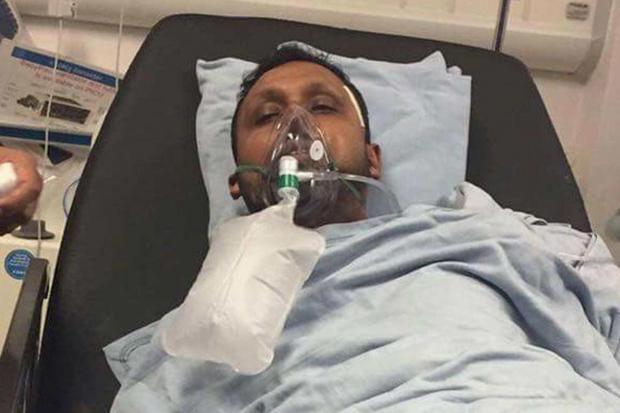
husband knifed in 'kill a Muslim' train attack

victim.jpg
Pic: Muhammed-Askar Ali in hospital
Crime reporter(wp/es):
A wife told today of the horrific moment her husband was stabbed on a train by a man allegedly shouting: “I want to kill a Muslim.”
Kulsuma Ali, who wore a hijab, was sitting beside husband Muhammed-Askar during the attack. She spoke as her family released a photograph of him fighting for his life in a London hospital.
The father-of-three suffered a punctured lung and stab wounds in his head and body from the onslaught on a train at Forest Hillstation.
Mrs Ali, 39, told the Standard a “hero” nursestepped in to help save his life as he bled heavily from multiple knife wounds. His condition in hospital is described as serious.
Speaking from the family home in Wandsworth, Mrs Ali gave her first public account of the attack on Monday just after 1pm.
She told how she saw a man staring and shouting, “I am going to kill a Muslim”, moments before the stabbing took place.
“He was shouting go back to Syria and things like that,” she said.
“It was terrifying. The man lunged forward and stabbed my husband  in the head first and then twice in  the chest and then three times in  the back.
“One wound is near the lung and very dangerous and the doctors are very worried about his sight because he was stabbed near the eye.
“The blade was a big kitchen knife. The man was wandering around with it and showing it but no one had stopped him. How can he not have been stopped before?
“No one came to help us at first. My husband had been stabbed loads of times before anyone moved.
“I was in total shock and was holding him. A lady on the train who was a nurse helped.
“She was amazing. I need to say thank you — she has maybe saved  his life.
“There was blood everywhere. I was in shock and I have not slept since. The scene keeps playing in  my head.”
The couple have three sons, who have not been able to go to school since the shocking event.
The victim is a delivery driver  and family man, who is described  by his wife as a “brilliant father  and husband”.
The couple, who are of Bangladeshi origin, had visited a mosque for prayers earlier in the day before  the stabbing.
They had then gone to pick up some flight tickets and were taking the train home.
A man aged 38 has appeared in court charged with attempted murder, possession of an offensive weapon and assault by battery.

Liberal Democrats jump to best poll rating in five years

Political reporter(wp/es):
The Liberal Democrats have jumped to their best poll rating in five years after the Richmond Park by-election, an exclusive poll reveals today.
Their vote is up from 10 to 14 points in the monthly Ipsos MORI Political Monitor survey - their biggest share since August 2011.
At the same time, leader Tim Farron’s personal ratings have improved, with satisfaction in his performance rising from 23 per cent to 27.
And the research found the Lib-Dems a clear five points ahead of Ukip, who are also up slightly.
The apparent success vindicates Mr Farron’s decision to pour the party’s resources behind Sarah Olney’s triumph in unseating Zac Goldsmith in the west London by-election, which his team pitched as a battle of soft versus hard Brexit.
The party has languished since former Deputy Prime Minister Nick Clegg led his side into Coalition with David Cameron and promptly raised maximum university fees.
In other key findings today:
  • Theresa May’s Conservatives have an 11-point lead Jeremy Corbyn’s Labour, with the Tories at 40 per cent (down two points) and Labour on 29 (down four).
  • Mr Corbyn has the worst ratings of any of the four main British leaders, with just 26 per cent satisfied with him and a two-to-one majority of 58 per cent dissatisfied.
  • Ukip has improved two points with Paul Nuttall installed as new leader but they are in fourth place, at nine per cent. Half the public do not yet have a view on Mr Nuttall’s performance in the job - and of those that do, they are two-to-one dissatisfied.
  • Caroline Lucas’s Greens are marooned on three per cent - a point below the combined support for Scottish and Welsh Nationalists who do not campaign in England.
  • Satisfaction with the Government has dropped since November, with the proportion who are satisfied with the way it is running the country falling from 43 per cent to 36. Satisfaction with Mrs May has dropped from 54 to 50 but her ratings are higher than the other leaders.
  • Experts cautioned Mr Farron, who was campaigning on the NHS in his constituency this morning, not to be surprised if the apparent bounce fails to last.
    Gideon Skinner, head of political research at Ipsos MORI, said: “Richmond Park was a positive sign – and news story - for the Lib-Dems after their lows in recent years.
    "But as always no-one should get carried away from just one poll. There’s still a very long way for them to go, and it could just be a short-term effect.”
  • Meanwhile, economic optimism has dipped in the past month. Half (51 per cent) think things will get worse in the year ahead, with just 24 per cent thinking they will get better.

In 100 years Central London to get first new park

Staff reporter(wp/es):
The first new park in central London in 100 years is to be opened as part of a funding package announced by Transport for London today. 
The £220 million pot will be distributed to town halls across the capital to pay for improvements to local transport, town centres and public spaces. 
Transforming Alfred Place in Fitzrovia, a few minutes’ walk from the British Museum, is among the projects intended to make boroughs greener, healthier and safer.
Camden council, which will get £6.7 million from TfL, has said the new park could be open by summer 2017, though the timetable has not been confirmed. 
The borough’s plans also include opening up Tottenham Court Road to two-way traffic — restricted to buses and cyclists during the day — segregated cycle lanes on Gower Street, and other public realm improvements in the local area. 
Each of London’s 33 local authorities will get something from the funding pot, which includes £148 million invested through Local Implementation Plans for transport schemes and £70 million for projects such as Quietways and Mini-Hollands for pedestrians and cyclists.
Westminster’s £3.6 million will help transform cycling, walking and buses round the Strand and Aldwych, while plans are under way to improve Baker Street and Gloucester Place.
There will be cash too for public spaces around Bond Street. 
Lambeth’s £3.8 million covers improvement works at Norwood Road, while Croydon will get £2.9 million for projects including transforming South Norwood town centre and widening and decluttering pavements and cycleways. 
Outer London will also benefit with Merton getting £2.9 million, including more than £1 million for Mitcham town centre, and Hounslow  £2.6 million for projects such as a new Greenways route alongside the Longford River linking Hanworth Park to Feltham town centre. 
Havering receives £2.3 million, including £250,000 for a new building at Romford Market, and Bexley £1.9 million, including £500,000 for safety measures to reduce collisions, particularly around schools.

Royal London Hospital security slammed over fears mothers could leave with wrong baby

Health reporter(wp/es):
NHS inspectors today criticised one of Britain’s biggest hospitals for failing to cut the risk of new-born babies being abducted from its maternity wards.
The Care Quality Commission said an electronic tagging system had yet to be introduced at the Royal London, in Whitechapel, almost two years after it first raised concerns.
A new CQC report rated the Royal London’s maternity services “inadequate” and said the hospital, rebuilt at a cost of £650 million, overall “required improvement”, though its adult major trauma unit was rated as outstanding.
Inspectors found midwives, of whom there was a shortage, “felt at risk at night” and there were “no checks” on who was visiting the post-natal ward.
During one inspection seven babies were not wearing identity wristbands, creating a risk that they would receive the wrong medicine or that mothers would leave with the wrong baby.
The report said: “Babies’ security was not treated as a priority.” It suggested an ongoing cash crisis had delayed the introduction of a tagging system.
Barts Health, which runs the Royal London, is the most indebted trust in the NHS, with an expected deficit of £82.7 million this financial year.
Trust bosses said the report misunderstood the proposed tagging system and insisted security had been upgraded.
There have been no cases of babies being abducted or of attempted abductions. The report said: “We had been told in July that a business case for baby tagging had been approved and would be implemented by autumn 2016.
“However, we found in September that electronic tagging had been deferred until the next financial year.”
CQC chief inspector of hospitals Sir Mike Richards said: “Most worrying of all was the lack of a safe and secure environment for new-born babies. We raised this with the Royal London as a matter for their urgent attention.”
A separate CQC report also published today found Whipps Cross Hospital, in Leytonstone, also run by Barts Health, was still inadequate. Barts Health is still in special measures and experts admit its new bosses have a “Herculean task”.
Trust chiefs said Whipps Cross Hospital made huge advances in the last year and was set to emerge from the bottom-rated category in six months.
Inspectors who visited in the summer found “many examples” of a lack of compassion to patients nearing the end of their lives. Some were “visibly in pain” but were not given painkillers.
Improvements were found in safety and effectiveness but change was “too slow”. Trust chief executive Alwen Williams said it was “on the right track”.

All new police officers in England will need degrees

Staff reporter(wp/es):
All new police officers in England  will have to be educated to degree level from next year, it has been announced.
A paid three-year "degree apprenticeship" is among three options open to people wanting to join all forces, including the Met, under changes unveiled by the College of Policing.
Would-be police officers can alternatively do an unfunded degree in policing or a funded postgraduate conversion course if they already have a degree in a different discipline, the professional body said.
Chief Constable Alex Marshall, the college's chief executive, said the changes would ensure forces were better placed to address changes to crime-fighting.
He said: "At the moment, it is very lopsided and we don't do a lot of professional development in policing.
"If you compare it to medicine or the military, there is massive investment in training and development, in policing there is a tiny investment.
"The nature of police work is getting quite complex and it is quite contentious and the public expectation is that you'll be patrolling in my street, and by the way you'll be patrolling online.
"We don't think the investment has been made in policing in terms of professional development and this is one of the ways that we start to address that."
Mr Marshall said the college would use its powers to force through the changes, which would mean "the public should receive the same level of service regardless of where they live". The current recruitment system varies from force to force.
The apprenticeship, due to be introduced next year, will see recruits undertake a three-year course, while receiving a salary and having the university academic component funded by their respective force.
The postgraduate conversion course would last six months and would also be funded by police.
In contrast, the policing degree would have to be self-funded and the student would still have to successfully apply to become a police officer after completing it.
Mr Marshall said the college was in discussions with 12 universities about the new system.
The money for the apprenticeships is expected to come from the apprenticeship levy due to come into force in April. This forces employers with an annual salary and pay bill of more than £3 million to spend the equivalent of 0.5% of it on apprenticeships.
The announcement comes following a two-month public consultation, which received more than 3,000 responses, almost 80% of them from police officers.
Mr Marshall said: "One of the big things we got back from the public and people in policing was be careful not to exclude good people who couldn't afford to go and get a degree because their parents can't help them, or whatever it will be."
Other changes that will be introduced include a national set of qualifications for officers following promotion, including a requirement that all applicants for the rank of assistant chief constable or above have a master's degree.
A higher-paid "advanced practitioner" position will also be created to entice people to remain in specialist areas such as cyber crime, instead of seeking a promotion that would take them to a different area.
Andy Fittes, general secretary of the Police Federation of England and Wales, said it generally supported the apprenticeship plan, but added: "The most fundamental and important question that must be answered though, is how does this proposal benefit the public the police serve?
"What is the benefit to the public, in terms of policing delivery, to have officers hold pre-joining qualifications, or serving officers becoming accredited?"
He added: "There is a balance to be struck around encouraging people to have a certain level of education before joining the force, and marginalising and excluding good quality candidates from all communities by limiting the pool of potential candidates if they are unable to afford it."
Chief Constable Giles York, the National Police Chiefs' Council lead for workforce, said: "As crime and demand change, so must policing. Our workforce is our most valuable resource, so police officers and staff need the right skills, knowledge and attributes to prevent harm and keep people safe in the 21st century.
"The changes announced today will help modernise the service and improve our ability to attract and retain really good people. It is also fair and right that police officers, as professionals, receive the recognition and accreditation they deserve, meaning the public will continue to get the high quality service they need."