Monday, 8 May 2017

Conservatives to retain 'tens of thousands' immigration pledge

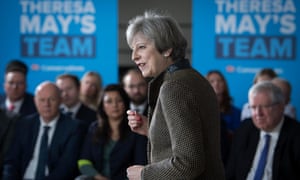
Theresa May addresses the Conservative party’s general election candidates from London and the south-east.
Pic: Theresa May addresses the Conservative party’s general election candidates from London and the south-east. 
Political reporter(wp):
Theresa May has confirmed that the Conservative pledge to cut net migration to the tens of thousands will be in her party’s manifesto, despite having missed the target after making the same promises in 2010 and 2015.
“We do want to bring net migration down to sustainable levels. We believe that is the tens of thousands,” the prime minister told journalists at an event in the constituency of Harrow West to launch the campaigns of Conservative candidates for London and the south-east.
May, who oversaw immigration policy during more than six years at the Home Office, claimed that Brexit would help her achieve the aim. “When we leave the European Union we will have the opportunity to make sure we have control of our borders – leaving the EU means we won’t have free movement as it has been in the past,” she added.
Senior party sources have told the WP that sticking to the policy was largely about perception so that voters see the government working towards the goal even if it is internally thought to be difficult to achieve.
They said the prime minister would also want to keep student numbers in the overall net immigration figure, despite cabinet ministers such as Boris Johnson thinking they should come out, because taking them out would look like trying to “rig the rules”.
May made the comments in an event centre on an industrial site in Harrow to scores of south-east and London candidates including cabinet ministers Damian Green and David Gauke, the former justice secretary Michael Gove and former MPs Nick de Bois and Mary Macleod, who hope to win back their old seats. The group was joined by journalists and surrounded by banners that read “Theresa May’s team”, with the word “Conservatives” in much smaller print.
The prime minister also suggested that the victory of Emmanuel Macron in France would boost the EU27 in Brexit talks.
“Yesterday a new French president was elected – he was elected with a strong mandate which he can take into a strong position in negotiations. In the UK we have to make sure we’ve got an equally strong mandate. And every vote for me and my team will strengthen my hand in those negotiations,” she said, triggering a huge round of applause from the gathered candidates.
In a personal attack on the Labour leader, May added: “And the alternative is to risk making Jeremy Corbyn prime minister, and try to picture him sitting at that negotiating table with the collective might of the European commission and 27 other European countries against him.
“A vote for any other party is a vote to be a step closer to Jeremy Corbyn sitting at that Brexit negotiating table – we must not let that happen.”
She was also asked about Macron’s previous comments about ripping up the Le Touquet treaty, a bilateral agreement that allows British border officials to be stationed in France, but has been controversial because of migrant camps in Calais.
May suggested the issue would be high on the agenda in June. “It works for the benefit of the UK and France and obviously the government that is elected on 8 June will be sitting down and talking to Monsieur Macron and others about how that system has worked both for the benefit of France and benefit of UK,” she said.

Sunday, 7 May 2017

Shadow chancellor John McDonnell promises tax hike only for people earning over £80,000

Political reporter(wp/es):
Labour will raise income tax only for people earning £80,000 and above, the party’s shadow chancellor will officially announce today.
If elected in next month’s General Election, John McDonnell promised Labour will fund their spending on public services by a hike in tax for wealthier people.
Mr McDonnell said the pledge would mean only the top five per cent of earners would face tax increases, while his "personal tax guarantee" would protect 95 per cent of workers - anyone earning less than £80k - from increases.
The move will be read by many commentators as a bid to attract more low and middle-income workers.
Mr McDonnell said the Labour manifesto for the June 8 election will also include a promise of no rises in personal national insurance contributions (NICs) or VAT over the course of the five-year parliament, due to end in 2022.
Speculation is rife that Prime Minister Theresa May is preparing to ditch predecessor David Cameron's 2015 pledge not to raise rates of income tax, national insurance or VAT until 2020, after Chancellor Philip Hammond said last month he would like "more flexibility" on the issue.
Mr Hammond was forced by the 2015 pledge to dump planned reforms to NICs in the Budget.
Detailing the plans in a speech in London on Sunday, Mr McDonnell is expected to say Labour is now the only party committed to not raising taxes on middle and low-earners.
He will spell out his economic vision for a richer Britain in what he terms a "big deal to upgrade the economy".
"If Labour is elected next month we will guarantee that for the next five years there will be no tax rises for income taxpayers earning less than £80,000 a year, no hikes in VAT, and no changes in your National Insurance Contributions either," he will say.
"The Labour Party is now the party of low taxes for middle and low earners, while the Tories are the party of tax handouts for the super-rich and big corporations.
"That is why every time Theresa May and the Tories are asked whether they are planning tax increases if they are re-elected on June 8, they run and hide."
Mr McDonnell will accuse Mrs May of refusing to take part in TV debates in order to avoid being put on the spot over tax.
"They are so determined not to be questioned on their plans, the Prime Minister refuses to take part in any TV debates and will only visit workplaces if there are no workers there, just her own party's activists," he will say.
"The Tories are hoping that the British people can be kept in the dark about what the tax increases they are planning will mean for those on middle and low incomes, who have had to bear the brunt of seven years of austerity."
Conservative chief secretary to the Treasury David Gauke said: "Jeremy Corbyn will have to raise taxes because his nonsensical economic ideas don't add up and he'll make a mess of the Brexit negotiations."
Liberal Democrat Treasury spokeswoman Baroness Kramer said: "Labour's so-called tax pledges aren't worth the paper they're written on, given their inability to form a proper opposition, let alone a government.. Labour has a spending list as long as your arm yet does not explain how to pay for it."

Saturday, 6 May 2017

Man arrested after teenage girl raped outside shopping centre in west London

Crime reporter(wp/es):
A man has been arrested after a teenage girl was raped outside a west London shopping centre.
The 17-year-old was forced towards the entrance of West 12 shopping centre in Shepherd’s Bush before the terrifying attack.
Earlier this week police put out a public appeal to help trace a man pictured in CCTV camera footage.
On Saturday detectives announced a man has been arrested in connection with the attack.
The suspect was questioned at a London police station and has been released on bail.
According to police, the alleged rape happened on October 27 last year. The victim and her friend were shopping in Westfield when they were approached by two men who they spent some time with and “lured them into a false sense of security”, police said.
The friends were split up and later that night the 17-year-old girl was attacked.

Karolina Chwiluk stabbed to death in east London

karolina2.jpg
Pic:Murder victim Karolina Chwiluk
Crime reporter(wp/es):
Police have launched a manhunt for the ex-boyfriend of a young woman knifed to death in east London.
She had been visiting the home of ex-boyfriend Grzesiek Kosiec, 23, when a fight broke out between the pair, Scotland Yard said.
A woman, aged 42, and a man, 24, who also lived at the house, stepped in to protect the 20-year-old victim but were also injured.
Miss Chwiluk, who is yet to be formally identified, was pronounced dead at the scene.
The suspect fled the scene before police arrived.
Detective Chief Inspector Chris Jones from the Homicide and Major Command urged anyone who knows where Mr Kosiec is to call 999 and warned members of the public that “he is violent”.
He said: "I would like to speak to Kosiec about the murder of Karolina. He was last seen at the house where she and two others who were trying to protect her were stabbed.
"It may be that friends of Kosiec who do not realise what has happened are giving him a place to stay, or other help. If that is the case, I'd urge them to get in contact with us as soon as possible.
"If you see Kosiec, or have information about where he may be, please contact us. He is known to work in south London and to have links to Tottenham.
"Given what took place at Dora Street that night, I have every reason to believe that he is violent, and so would ask anyone who sees him to call police immediately." 
The suspect, from Poland, is described as 5ft 10ins tall and of skinny build.
He has brown hair usually worn in a top knot and was last seen wearing black jogging bottoms and a dark t-shirt, police said.

Man, 23, becomes second victim of fatal knife crime on capital's streets in 12 hours

Crime reporter(wp/es):
A 23-year-old man has been stabbed to death in the street in north London, becoming the second person to die from knife crime in the capital in less than 12 hours.
Police rushed to Waterloo Road, Uxbridge, shortly after 1am on Saturday to reports of a man found in the street with stab wounds.
He was taken to a west London hospital where he was pronounced dead a short time later, Scotland Yard said.
The victim, from Hayes, west London, died less than 12 hours after a man, aged in his 30s, was fatally knifed during a fight in a barber's shop in Harlesden on Friday afternoon.

He is the ninth person to die from knife crime on the streets of London in just two weeks.
Police have urged witnesses to the attack to come forward.
Detective Chief Inspector Andrew Packer said: "A young man has lost his life and I am appealing to the public to give us all the help they can.
"In particular I would ask anyone who was in the vicinity of Waterloo Road from midnight to early in the morning to call us.
"If you saw or heard anything please do not hesitate; your information could be vital."
The victim’s next of kin have been informed but formal identification is yet to take place, a Met Police spokesman said.
He added: “No arrests have been made and enquiries continue.”

Friday, 5 May 2017

Man dies after being hit by lorry on busy road in south-east London

Staff reporter(wp/es):
A man has died after being hit by a lorry on a busy road in south-east London.
Emergency services rushed to the scene of the crash on the south circular in Catford at 12.30pm on Friday.
Paramedics and firefighters attended while London’s Air Ambulance was also scrambled.
The man, whose age is not currently known, was pronounced dead at the scene, police said.
Tim Gluckman, who witnessed the aftermath of the incident, said a "very big lorry" had hit the man.
He said: "Lots of police vehicles, lots of ambulances and the fire brigade are all here.
"They keep increasing the size of the police cordon."
A spokesman for the Met Police said: “The driver of the lorry was uninjured.
“The male pedestrian received life threatening injuries and was pronounced dead at the scene.
“Next of kin have not yet been informed.
“No arrests have been made and enquiries continue.”

Local elections Tories gain over 500 seats as Labour and Ukip votes plunge

Political reporter(wp):
The Conservatives have gained more than 500 seats in local elections across England, Scotland and Wales, with Labour declining significantly and Ukip facing a near total wipeout of its county council seats.
Labour also performed worse than expected in elections for new metropolitan mayors, winning the contests in Liverpool and Manchester, as expected, but losing out to the Conservatives in Tees Valley, traditionally a Labour heartland. In the West Midlands, the Conservatives’ Andy Street narrowly beat Labour’s Siôn Simon.
With just five weeks to go to the general election, Jeremy Corbyn’s party blamed “unique circumstances” for a challenging set of results in Thursday’s polls. The numbers are ominous for Labour’s prospects in the general election, with the Conservatives benefiting from the huge decline in support for Ukip.
Theresa May, however, said she was “not taking anything for granted” about the general election, insisting she believed Labour could still win.
Speaking to reporters after a visit to a factory in Brentford, west London, the prime minister again tied her electoral fortunes to what she said was interference from forces within the EU which hoped to undermine Brexit.
“The reality is that, despite the evident will of the British people, we have bureaucrats in Europe who are questioning our resolve to get the right deal,” she said. “Only a general election vote for the Conservatives will strengthen my hand to get the best deal on Brexit.”
A forecast return of voters to the Liberal Democrats failed to materialise, with the party seeing a net loss of 36 seats. Ukip meanwhile, took just one seat and lost 140.
By comparison, the Tories had gained more than 530 seats across the three nations. Labour had lost almost 370, split more or less evenly between England, Scotland and Wales. In Scotland, the party lost control of Glasgow council for the first time in more than 35 years.
BBC estimate of the projected national share of voting – what vote proportions would be expected if every British ward had taken part – put the Conservatives on 38%, Labour on 27%, the Lib Dems on 18% and Ukip on 5%.
Corbyn was en route to Liverpool to congratulate the new Labour mayor, former MP Steve Rotherham. He also tweeted congratulations to Welsh Labour for “defying the pundits”.
John McDonnell, the shadow chancellor, said he accepted it had been a “tough night” but defended Corbyn’s performance and told ITV it had “not been the wipeout people were expecting”.
The Conservatives gained control of at 10 English councils – Cambridgeshire, Derbyshire, East Sussex, Gloucestershire, Isle of Wight, Lancashire, Lincolnshire, Norfolk, Suffolk and Warwickshire. Derbyshire was taken from Labour, with the others formerly under no overall control.
Two of the most significant results were in the north, where Labour has dominated local government for many decades. The Conservatives became the largest party on Cumbria county council in north-west England and Northumberland in the north-east, where it was denied a majority when a Lib Dem candidate beat a Tory by drawing straws to settle a tied result.
In Wales, the Tories gained more than 70 seats and independents have added 10, while Labour lost seats but remained the most dominant party. The Tories gained Monmouthshire council, while Labour lost control of Blaenau Gwent and Bridgend but strengthened its presence in Swansea.
The Lib Dems failed to make the gains they were hoping for in the south and south-west, and were showing a net loss of 32 seats.
Ukip – which lost its presence on Lincolnshire, Essex and Hampshire councils – took until after midday to win a single seat, taking a Lancashire ward from Labour.
The Ukip leader, Paul Nuttall, said it had been a difficult night for the party but that it may almost have been a worthwhile sacrifice given the Conservatives’ embrace of Brexit.
“If the price of Britain leaving the EU is a Tory advance after taking up this patriotic cause, then it is a price Ukip is prepared to pay,” he said in a statement.
The Greens and Plaid Cymru were the only parties other than the Tories to win ground.
The first metro mayoral result to be announced was for the West of England area including Bristol, Bath, north-east Somerset and south Gloucestershire, which went to the Conservative candidate, Tim Bowles.
The former Labour MP Steve Rotherham won the Liverpool mayoralty, with 59% of the first choice vote, and former Labour cabinet member Andy Burnham won in Manchester, with 63%, but the Conservative Ben Houchen narrowly beat Labour’s Sue Jeffrey in Tees Valley when second-preference votes were counted.
Former John Lewis boss Andy Street narrowly won the tightly fought West Midlands mayoralty race against Labour’s Siôn Simon.
After polls closed, Corbyn’s team played down expectations of Labour’s performance, accepting that the party could lose hundreds of seats.
The party said it performed strongly in 2013 when the same council seats were last contested and it was confident its message would start to resonate as 8 June approached.
Diane Abbott, the shadow home secretary, told the BBC that not too much should be read into “a relatively low turnout type of election”. She said: “At the general we will have a higher turnout. And I believe that Labour voters will be repelled by Tory triumphalism and the notion of giving Theresa May some kind of blank cheque.”
But Philip Johnson, a Labour parliamentary candidate for Nuneaton who lost his Warwickshire council seat, said Corbyn was “putting off” some voters. Stephen Kinnock was also forthright in his criticism of the leadership and argued the party needed to make the general election about the wider team.
He told the BBC: “I think we can’t just put a spin on this – the fact of the matter is that Jeremy’s leadership does come up on the doorstep on a very regular basis. What we have to do is make this election about more than leadership; we’ve got to make it about the future of our country.
“We are seeing from people on the doorstep that they are worried about the polarisation of our politics; they do feel there is a shift to the hard-left and a shift to the hard-right. And my vision of the Labour party is not one where we are anywhere near the hard-left. We are a party that is a centrist, patriotic party that stands up for working people.”
McDonnell said Labour’s policies were going down well and people would like Corbyn more as they were exposed to him more.
“I’m not underestimating the challenge we face across the country, but what I’m saying is it wasn’t the wipeout many predicted,” he told the BBC. “It is much better and I think we turned out our vote in ways people didn’t expect. In the national campaign, we have set out extremely popular policies and this issue about Jeremy Corbyn, in the very area he campaigned, Cardiff, we actually held on to it well.”
McDonnell said there would be balanced airtime in the broadcast media during a general election, counteracting “unbalanced media reporting of [Jeremy Corbyn] for the last two years”.
“What we’re finding is people like the policies and then they see Jeremy Corbyn is an honest, decent but also principled man, so the more airtime we get the better,” he said.
Up for grabs were seats on 35 English councils – most of them county councils – and every council seat in Scotland and Wales. Turnout in England is expected to have been about 35% – slightly up on the last comparable elections.
Strategists from all the major parties will be scrutinising the results closely for signs that May’s relentless message of providing “strong and stable leadership” has won over habitual Labour voters.
The Conservatives have been trying to play down the results for fear supporters may not bother to turn out at the general election in anticipation of a landslide for May.
Michael Fallon, the defence secretary, denied that the Conservatives were benefiting only from Ukip’s demise, attributing some of the party’s advances to “Jeremy Corbyn’s very feeble leadership”.
Anthony Wells, of the pollsters YouGov, said Labour was just three percentage points behind the position Margaret Thatcher’s Conservatives were in at the 1983 local elections, but trailed by 16 points in the general election that followed just a month later.
Wells said: “Don’t just assume that the projected overall shares of the vote at this week’s votes are going to be repeated in next month’s election. People vote differently for different reasons at different sorts of election.”