The murder investigation is being conducted by officers from the East Midlands Specialist Operations Unit, which has appealed for witnesses to come forward.
Supt Di Coulson said: "This is a tragic crime and our thoughts are with the family and friends of those involved.
"We are in contact with the families and will ensure that this is a thorough investigation as we try to understand what happened."
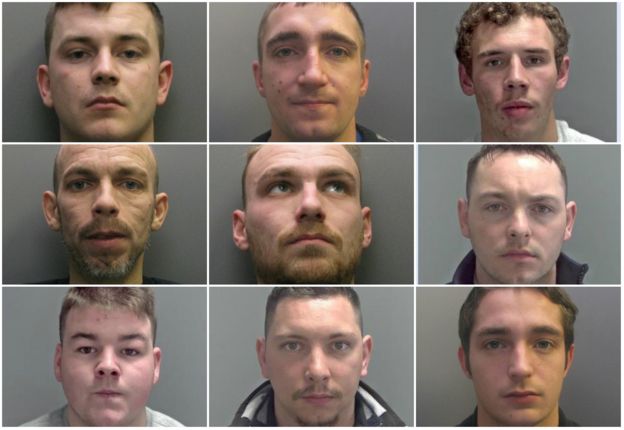
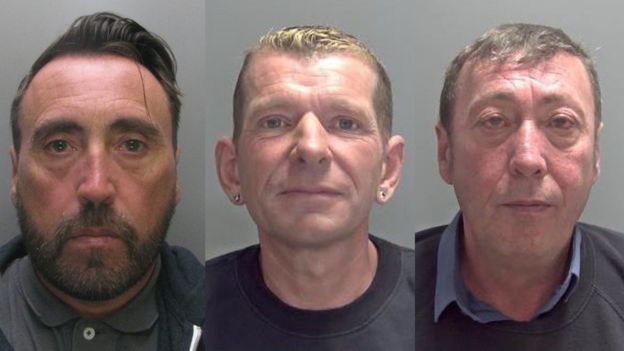
Pic-1:(Left to right, top row to bottom) Charlie Webb, Danny Stone-Parker, Joe John Spencer Loveridge, John Eli Loveridge, John Stanley Loveridge, Johnny Oakley, Joseph Holmes, Richard Oakley, Timothy Stone-Parker/bbc-wp Pic-2:Thomas Pateman, Simon Oakley and James Pateman were found guilty at Norwich Crown Court/wp/cambridgeshire police Crime reporter,cambridgeshire(wp/bbc):
Rolex watches, diamond rings and coins are among "thousands of items" police are hoping to reunite with their owners after a gang responsible for 250 burglaries was jailed.
The "prolific criminal gang" broke into homes and businesses and stole cash machines across Cambridgeshire, Bedfordshire, Norfolk, Suffolk and Essex.
The burglary rate in Norfolk halved after the gang, aged 20 to 55, was arrested in December 2017, police said.
The gang favoured homes in rural areas, where they could make easy getaways and stole high-performance vehicles to give themselves a better chance of out-running police.
Detectives said those who believe any of the items belongs to them should get in touch with their details, including a crime number and proof of purchase or photographs.
The nine convicted over the burglaries were:
Charlie Albert Webb, 20, from Newton Flotman, Norfolk
John Eli Loveridge, 42, of Greenways, Carleton Rode, Norfolk
John Stanley Loveridge, 23, of Greenways, Carleton Rode, Norfolk
Joseph Holmes, 21, of Schole Road, Willingham, Cambridgeshire
Danny Stone-Parker, 28, of Braintree Road, Great Dunmow, Essex
Timothy Stone-Parker, 24, of Clay Way, Ely, Cambridgeshire
Joe John Spencer Loveridge, 19, of Winchester Road, Sandy, Bedfordshire
Richard Oakley, 27, of Sandy Park, Beck Row, Suffolk
Johnny Oakley, 25, of Sandy Park, Beck Row, Suffolk
Simon Oakley, 45, of Alburgh Road, Hempnall, Norfolk, was also found guilty of conspiracy to burgle in November.
Brothers Thomas Pateman, 54, of Fen Road, Chesterton, Cambridgeshire and James Pateman, 55, of Woollensbrook, Hoddesdon, Hertfordshire were found guilty of handing stolen goods.
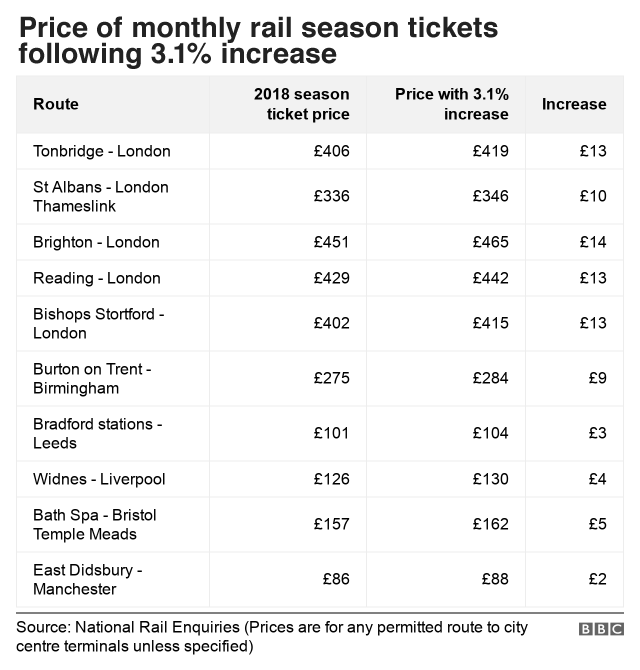
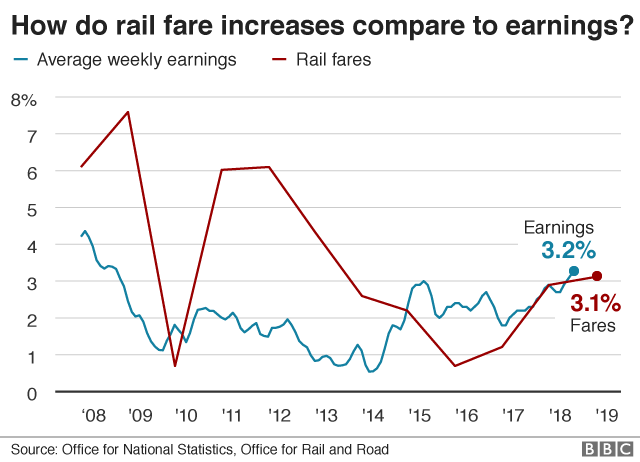
Rail fares have increased by an average of 3.1% in England and Wales - and almost 3% in Scotland - despite a raft of issues on the network in 2018.
The rail industry says 98p of every pound spent on a ticket is invested back into the network.
But Wednesday's price hike was called "yet another kick in the wallet" by campaign group Railfuture.
Transport Secretary Chris Grayling said the government had made a "record investment" in rail.
Labour leader Jeremy Corbyn condemned the increase as a "disgrace" and said it "drives people away from public transport".
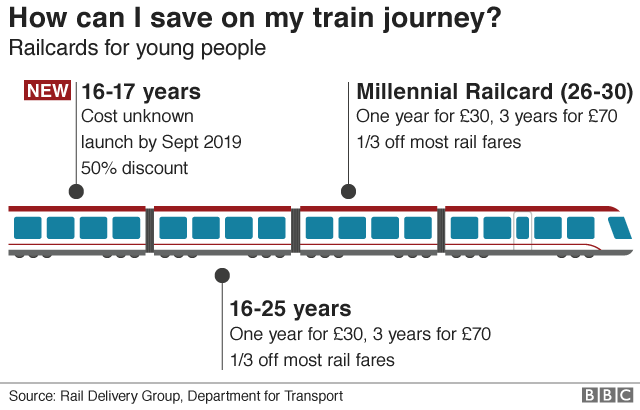
Mr Grayling also announced that a new railcard extending child fares to 16 and 17-year-olds in full-time education or training will be available by September.
Initial demand for the new railcard was high - Network Rail's online queuing system showed wait times of more than an hour.
Some fares in London will stay the same after a decision by Mayor Sadiq Khan to freeze Transport for London prices. However, on average Travelcards and price caps have increased by 3.1% in London.
Campaigners held protests against rises outside stations across the country.
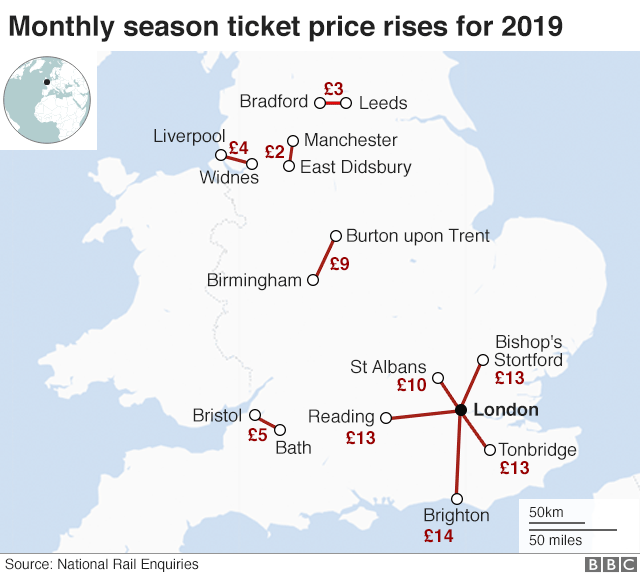
The rise in England and Wales - the highest since January 2013 - will see the price of some annual season tickets go up by more than £100.
The company said its fare rises were lower than in England and Wales, adding that it was investing "millions of pounds to build the best railway Scotland has ever had".
Analysis from the Labour Party of more than 180 UK routes claimed that since the Conservatives came into power in 2010, the average commuter is paying £786 more for their annual season ticket.
The increases come despite one in seven trains being delayed by at least five minutes in the past 12 months - the network's worst performance since September 2005, according to the Press Association.
Shadow transport secretary Andy McDonald said the latest increases were "an affront to everyone who has had to endure years of chaos on Britain's railways".
Around 45% of fares are regulated by government, and capped at July's retail price index inflation figure - 3.2%.
Other increases are decided by the train companies.
Transport secretary Chris Grayling blamed unions for threatening a national strike when the government offered to use a lower measure of inflation for fare increases in return for smaller pay rises.
Mr Grayling told BBC Radio 4's Today programme: "The reality is the fare increases are higher than they should be because the unions demand - with threats of national rail strikes if they don't get them - higher pay rises than anybody else."
Mick Cash, general secretary of the Rail, Maritime and Transport Union, said it was "scandalous" that Mr Grayling was trying to blame rail workers for problems "caused by privatisation of the railways".
'Value for money?'
Robert Nisbet, regional director of industry body the Rail Delivery Group, said investment was at its highest level since the Victorian era and "that money has to come from somewhere".
He said by 2021 there would be 7,000 new carriages across the country and 6,400 new services.
The UK's railways are predominantly funded by customers' fares: last year's figures from the Office of Rail and Road show they yield £9.7bn, while the government provides £6.4bn - excluding loans from Network Rail.
However, almost a third of the government funding was given specifically to the HS2 high-speed rail project.
Campaign group Transport Focus said only 45% of passengers were satisfied with the value for money of their tickets.
Chief executive Anthony Smith told the BBC: "The industry should be becoming more efficient and that efficiency should be passed back to passengers to reflect a poor year."
The Department for Transport has commissioned former British Airways chief executive Keith Williams to carry out a review of Britain's railway network - including fares.
Crime reporter(wp/reuters): A 25-year-old man suspected of stabbing three people with a kitchen knife at Manchester Victoria train station on New Year’s Eve was being held and assessed for mental health issues on Tuesday, police said.
Greater Manchester Police were, however, continuing to investigate the attack because of suspected links to terrorism, they said in a statement. A raid of the man’s home in the city’s Cheetham Hill area was still taking place.
The man’s name has not yet been released and police did not return requests for further information.
A witness, a BBC producer who was at the busy station full of New Year’s Eve revellers, said a man stabbed several people at the station, shouting “Allah” and linking his actions to “bombings in other countries.”
The station is very close to Manchester Arena, where a suicide bomb attack in May 2017 killed 22 people as they left a concert by pop star Ariana Grande.
Those wounded, a woman and a man in their 50s, were in a serious but not life-threatening condition, police said. The other, a male police officer in his 30s who sustained a stab wound to his shoulder, was released from hospital earlier.
“The Counter Terrorism investigation remains ongoing,” police said. “There is nothing to suggest the involvement of other people in this attack, but confirming this remains a main priority for the investigation.”
Earlier, Chief Constable Ian Hopkins praised officers at the scene for their bravery in arresting the suspect within minutes.
Hopkins said many people would have been affected by Monday’s attack, particularly since it happened so close to the scene of the 2017 bombing.
“I believe that makes it an even more dreadful attack for our city,” he told reporters.
Britain is on its second-highest threat level of severe, meaning an attack is considered highly likely. Security officials say they are facing record levels of work in countering Islamist militants as well as far-right extremists after four major attacks last year.
Sam Clack, the BBC producer who witnessed the attack, told the broadcaster: “I just heard the guy shout, as part of a sentence, ‘Allah’.”
“I heard the man say, ‘As long as you keep bombing these countries this is going to keep happening’,” Clack told BBC 5 Live radio in another interview. “It was very, very scary.”
Prime Minister Theresa May said on Twitter: “My thoughts are with those who were injured in the suspected terrorist attack in Manchester last night. I thank the emergency services for their courageous response.”
Prime Minister Theresa May will find a way to get her Brexit deal approved by the British parliament, Foreign Secretary Jeremy Hunt said on Wednesday during a visit to Singapore.
May postponed a planned vote on her deal in December after admitting it was set to be defeated by lawmakers. She is seeking further assurances from European Union leaders ahead of a vote now due to take place later this month.
“When Theresa May comes back with those reassurances that she has been seeking from the EU that the deal that is on the table is not going to lead to us being permanently trapped in the customs union ... she will find a way to get this deal through parliament,” Hunt said during a question-and-answer session following a speech in Singapore.
Asked about the prospect of holding a second referendum on the deal, Hunt said it would be damaging to democracy and the social consequences of not leaving EU would be “devastating”.
Business correspondent(wp/reuters): UK shares were lower on Wednesday as investors returned from New Year celebrations to more disappointing data from China that deepened concerns about the health of the global economy and sparked a global sell-off.
London's blue-chip bourse .FTSE dropped 0.9 percent and the mid-cap index .FTMC dipped 0.3 percent by 1018 GMT.
Most sectors were still in the red, setting a bleak tone for 2019’s first trading day after both indexes recorded their worst yearly drop since the 2008 financial crisis last year.
Positive domestic PMI data due to Brexit-induced stockpiling provided some respite, but investors were focussed on Chinese data that showed manufacturing activity in the world’s second-largest economy contracted for the first time in 19 months.
It followed a poor official survey on factory output on Monday. Data also revealed that euro zone manufacturing activity barely expanded in December.
Continued concerns that the prospect of a global cyclical downturn will likely cap the upside of UK’s blue-chip shares, said CMC Markets analyst Margaret Yang.
“A string of missing PMIs from China’s official and private sector suggest that Asia’s largest economy is still cooling off due to weaker external demand and trade uncertainties,” Yang added.
“It is still too early to say markets have bottomed out yet.”
UK-listed companies with more exposure to the Asian market were the most hit with HSBC (HSBA.L) edging 1.8 percent lower and Standard Chartered (STAN.L) down 3 percent.
Fellow financial heavyweights Prudential (PRU.L), Lloyds (LLOY.L) and Royal Bank of Scotland (RBS.L) also fell over 3 percent.
Global miners were also weak with copper prices lower amid concerns over growth in top metals consumer China. Antofagasta (ANTO.L), BHP (BHPB.L), Anglo American (AAL.L), Rio Tinto (RIO.L) and Glencore (GLEN.L) were down between 3.2 percent and 4.3 percent.
Blue-chip medical products maker Smith & Nephew (SN.L) tumbled 2.5 percent, with traders citing a rating cut by brokerage JPMorgan.
Among the midcaps, Energean Oil & Gas (ENOG.L) added 5.1 percent to top the gainers after signing a gas supply agreement with independent power producer I.P.M. Beer Tuvia.
Elsewhere in corporate news, Ophir Energy (OPHR.L) shares outperformed the small-cap index .FTSC and soared over 33 percent after the oil and gas producer said it was in takeover talks.
Gambling software company Playtech (PTEC.L) gave up losses to turn positive. It said it would pay 28 million euros under a settlement with Israeli tax authorities following an audit of its annual accounts.
Real estate investment trust Hammerson (HMSO.L) was 3.9 percent lower as it said its share buyback programme will be paused ahead of the release of 2018 results.
The IHS Markit/CIPS Manufacturing Purchasing Managers’ Index (PMI) rose to 54.2 from an upwardly revised 53.6 in November, the highest reading in six months and stronger than all forecasts in a Reuters poll of economists.
Markit said the improvement did not herald a big change in the outlook for Britain’s stuttering economy and was caused in large part by manufacturers stockpiling inputs and finished goods, both of which were near record highs.
“Any positive impact on the PMI is likely to be short-lived, however, as any gains in the near-term are reversed later in 2019 when safety stocks are eroded or become obsolete,” IHS Markit director Rob Dobson said.
Many manufacturers are building up inventories to protect themselves against the risks of customs delays at the border after March 29 when Britain is due to leave the EU.
Prime Minister Theresa May is struggling to overcome deep opposition to her Brexit plan in her own Conservative Party, raising the risk that no transition period will be provided to ease Britain out of its four decade-long membership of the EU.
“The rush to stockpile goods ahead of Brexit ... is now in full swing. The absence of any New Year joy from the European PMI data also confirms that the near future holds a bumpy ride for UK manufacturers,” said Francesco Arangeli, an economist at the EEF manufacturing association.
The euro zone manufacturing PMI fell to its lowest since February 2016 last month, and a Chinese PMI contracted for the first time in 19 months.
The average reading for the manufacturing PMI in the three months to December was the weakest since the period just after the Brexit vote.
While the slowdown in Britain’s economy since the Brexit referendum in 2016 has not been as sharp as some forecasts made at the time, the country has lagged behind stronger growth in other economies.
Last month, the Bank of England cut its forecasts for quarterly growth to just 0.2 percent in the last three months of 2018 and the first quarter of 2019. It has warned that a worst-case Brexit could push Britain into a deep recession.
Wednesday’s survey suggested manufacturing output shrank slightly in the fourth quarter of 2018.
Export orders last month were their strongest since May after contracting in November and October, again partly reflecting stockpiling to mitigate Brexit disruption.
On prices, input cost inflation eased to a two-and-a-half- year low in December.