Saturday, 30 March 2019

Eurostar: Trains disrupted by protester near St Pancras

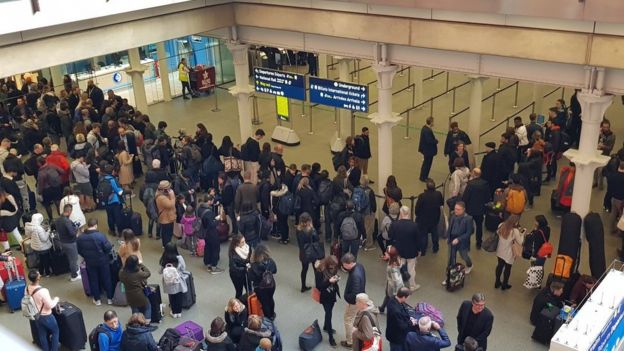
St Pancras crowds
pic-Passengers at St Pancras International have faced delays
Staff reporter(wp/bbc):::
Eurostar passengers face major disruption after a protester caused trains to and from St Pancras International to be suspended.
British Transport Police (BTP) said a man had been in "a precarious position" near the station since Friday evening.
Southeastern services heading towards St Pancras from Faversham and Margate have also been affected.
A man, 44, has been arrested for trespass and obstruction of the railway.
BTP confirmed eyewitness reports the man was waving an English flag.
It follows a day where thousands of people protested in central London over delays to Brexit.
Power to the overhead lines was switched off, so trains could not enter or leave St Pancras.
Shortly after 11:00 GMT, National Rail said Eurostar services started running again - but warned passengers to check before they travelled.
 National Rail statement said the protester spent the night on the railway viaduct that crosses the high-speed lines just outside the station.
He has now been removed and overhead wires have been recharged to allow services to resume, it added.
Passengers on Southeastern have been warned "alterations and cancellations" will remain in place for the near future.
They were previously advised to travel to Victoria or Charing Cross stations rather than St Pancras.

Pound set for weakest month in five after Brexit deal defeated again

Banking&Finance reporter(wp/reuters):::
The pound lurched lower on Friday after lawmakers rejected Prime Minister Theresa May’s Brexit deal for a third time, putting the British currency on track for its biggest monthly loss in five.
With May losing again - albeit by a smaller magnitude than the previous two votes - sterling is set to remain under pressure on fears the United Kingdom will crash out of the European Union without a deal on April 12.
Traders say the uncertainty about what happens next is hurting the currency.
“The focus now shifts to the alternatives that parliament will decide on next week and everything from revoking Article 50 to having a second referendum vote is on the table which will weigh on the pound,” said Nikolay Markov, a senior economist at Pictet Asset Management based in London.
The pound fell as much as half a percent to the day’s low of $1.2977, briefly piercing a key market level of the 200-day moving average at $1.2979.
It later stabilised near $1.3024, down 0.2 percent on the day, as traders bought back into the currency.
Against the euro the pound was 0.1 percent lower at 86.19 pence by 1620 GMT.
Moves in the pound were not as dramatic on Friday as with May’s previous parliamentary defeats - traders say investors have scaled back their trading of the pound because it has become so difficult to predict amid the constant and sometimes arcane political developments.

SLOW DEATH OF BREXIT?

Salman Ahmed, global investment strategist at Lombard Odier Investment Managers, said that although uncertainty persisted, the market was right to price out the risk of a no-deal exit from the EU. Sterling had fallen to below $1.25 last year on fears Britain would crash out of its biggest trading partner.
“If the deadline is extended longer we will re-engage with sterling because that will be the start of the slow death of Brexit,” Ahmed said.
After a special sitting of parliament, lawmakers voted 344-286 against May’s 585-page EU Withdrawal Agreement, agreed after two years of tortuous negotiations with the bloc.
The defeat now means that Britain now has until April 12 to convince the 27 capitals of the EU that it has an alternative path out of the impasse, or see itself cast out of the bloc from that date with no deal on post-Brexit ties with its largest trading ally.
On a monthly basis, the pound has fallen 1.9 percent, putting it on track for its worst monthly performance since October 2018.
(Graphic: GBP vol curve, tmsnrt.rs/2V2Y8b3)
Volatility indicators for the pound across the curve, a gauge of expected swings in the British currency in the coming months, fell across the board on Friday as traders took profits before the weekend.
One-month volatility gauges fell as much as 1 vol to 12.8 vol but still remained elevated by recent historical levels.
The lack of trading activity has reduced liquidity in the market, exacerbating swings in the currency.
British stocks weakened after May’s deal was defeated, giving up some of their earlier gains.
Core euro zone bond yields also fell after the vote as investors sought safety in government bonds.

Angry over Brexit delay, 'Leave' supporters march through London

Political reporter (wp/reuters):::

Thousands of people opposed to Britain delaying its departure from the European Union marched through central London on Friday as lawmakers in parliament strongly rejected Prime Minister Theresa May’s Brexit deal for a third time.
On the day that Britain was originally meant to be leaving the EU, large groups gathered in bright sunshine outside parliament waving Union Jack flags and chanting, “Out means out” - as the Queen song Bohemian Rhapsody was played on a loudspeaker with its famous lyric “Mamma Mia, let me go”.
Friday’s protest, a week after hundreds of thousands marched through calling for a second referendum, shows how divided Britain is over Europe three years after voting to leave the EU.
As the result of the vote in parliament filtered through to the crowds on Parliament Square, scattered cheers went up as some protesters viewed it as boosting the chance of a rapid departure from the bloc.
The mood of protesters ranged from satisfaction to despair.
“Excellent. We’re now on track for a ‘no deal,’” said saleswoman Louise Hemple, 52, standing in the shadow of Winston Churchill’s statue outside parliament. “And that will mean we’ll have complete control which is what we Brexiteers voted for.”
Hemple said she would continue to protest until Britain had left the EU because she did not trust lawmakers to do it.
“They’re in their bubble in there. It’s all about their vote, not our vote,” she said, referring to the 17.4 million people who voted Leave in Britain’s 2016 referendum.
Nigel Farage - the politician widely thought to have done the most to spook Britain’s then government into agreeing to hold the referendum - addressed the crowd at the end of a 270-mile (435 km), two-week march from Sunderland, northeast England, to London.
“What should have been a celebration is in fact a day of betrayal,” Farage told Reuters. “There will be a lot of anger. I certainly have never known a time in my life when people have said such rude things about the political class, about the government.”

BREXIT BETRAYED?

Earlier, about 1,000 Leave supporters had gathered at Bishop’s Park on the bank of the River Thames to march the four miles to parliament.
Among them was David Malindine, 63, a retired teacher.
“We need to remind the country that the majority of people voted ‘Leave,’” said Malindine. “This was the day we were supposed to leave, and Brexit has been betrayed.”
Many people said their central grievance was a political elite that doesn’t represent them.
One placard said: “Politicians worth their weight in cow dung.” Another said: “Parliament? A hive of scum and villainy.”
Labour Party politician Lisa Nandy - who opposed May’s deal - said that she and her staff were called traitors by protesters as she tried to enter parliament to vote.
Far-right Leave activists including Tommy Robinson spoke at a separate meeting nearby.
Robinson led the crowd in singing Rule Britannia. Propped on the stage beside him was a coffin with May’s face on it and the word “democracy”.
Some protesters dragged dummies wearing masks of May and Labour Party leader Jeremy Corbyn through the streets, leaving them outside the gates to May’s Downing Street residence.
Police said they were prepared for potential trouble, although the atmosphere was festive for most of the day with people drinking beer and eating sandwiches.
Later in the evening there was a small stand-off between Robinson supporters and police, as around 100 supporters protested outside May’s office shouting “We want Brexit! We want Brexit!”.
London’s police force said it had arrested five protesters as of 2100 GMT.
Many of the day’s marchers predicted the political elite will be punished if it fails to fully sever ties with Brussels.
Andy Allan, 58, who was carrying a red and white St George’s flag, predicted that there could be unrest modelled on the “yellow vest” protests that have rocked Paris for the last few months if Britain fails to leave the EU.
“It is absolutely disgusting what is happening,” he said. “Be warned - this is just the beginning of a mass uprising if we get betrayed by the politicians.”
All Brexit options are on the table - UK Conservatives chairman

Political reporter(wp/reuters):::
The chairman of British Prime Minister Theresa May’s Conservative Party said all options were on the table for how to get Britain out of its Brexit impasse but that seeking a customs union with the European Union would be difficult.
“We’ve got to look at what we can do next and we have to do something different,” Brandon Lewis told BBC radio on Saturday when asked if May might try to put her withdrawal agreement to a parliamentary vote yet again.
Lawmakers rejected May’s Brexit deal for a third time on Friday, leaving Britain’s withdrawal from the EU in turmoil on the day it was originally due to leave the bloc.
“Parliament will continue this process on Monday and we’ve got to look at all the options,” Lewis said.
With parliament and the government deadlocked on May’s deal, it remains unclear how, when or even whether Britain will leave the EU.
On Monday lawmakers will try to agree on an alternative Brexit plan that could command majority cross-party support. The options that have so far gathered most support involve closer ties to the EU and a second referendum.
Lewis said the option of a customs union would be difficult to pursue because it flew in the face of the Conservatives’ pledges before the 2017 national election and did not respect the outcome of the 2016 Brexit referendum.
When asked if a way out of the impasse was to hold a fresh national election, Lewis said he did not think British voters wanted to return to the polls.
The BBC said government officials had not ruled out the possibility of a run-off vote in parliament between the most popular option proposed by lawmakers and May’s deal.
Lewis backed May to continue as prime minister but said he was aware of a letter sent to her by Conservative lawmakers calling for her to resign.

Saturday, 9 March 2019

A speech by The Countess of Wessex at a reception for Women Peacebuilders, Buckingham Palace

Good afternoon and may I begin by wishing you all a happy International Women's Day. Your Excellencies, Minister, My Lord’s, Ladies and gentlemen, thank you for giving up your time today in support of not just International Women's Day, but in particular for the Women, Peace and Security and the Preventing of Sexual Violence Initiative.
The efforts to raise awareness of and support women peace-builders form part of the UK's strategy to implement the UNSCR 1325 WPS commitments, and have placed the UK in a pivotal role of putting more women and girls at the centre of conflict resolution, including encouraging more women peace-builders, female mediators, as well as supporting the survivors of sexual violence in conflict.
As someone who firmly believes in the equality of men and women, I feel drawn to your cause and to do what I can to help raise further awareness of your work.  To help give voice to women and girls who are being denied their fundamental rights as humans and are being subjected to harm and violence as a result of conflict, to promote those who seek to play a part in finding peace, and to support others as they attempt to rebuild their lives. Therefore I am publicly committing myself to doing what I can to champion and support WPS and PSVI and make this a central pillar of my work in the coming months and years.
Since last year I have been attending a number of conferences, meetings and events, and have encountered some extraordinary people during this time. People like yourselves who are devoted to doing what they can to tackle these issues from UK government representatives to the international diplomatic community, from academics to survivors. Whether their role be encouraging governments to do more to prevent violence being used as a weapon of war, or working to bring justice to the survivors of brutality, or supporting the many NGO's and agencies working to help women and girls rebuild and retake control of their shattered lives; the level of effort is widespread, but as yet it is sadly still not enough and we all know that so much more needs to be done.
I have also been fortunate enough to be able to meet 2018 Nobel Prize Laureate, Dr Denis Mukwege, who was here to attend the PSVI International Film Festival on his way to Sweden to collect his prize. Up until then I had been researching WPS/PSVI and trying to gain a better understanding.  There is, however, nothing like speaking to someone, who as a gynaecologist, has treated hundreds of victims of the kinds of rape and abuse that defies belief.  Dr Mukwege painstakingly stitches these women back together and does what he can to care for them.  It is so desperately sad therefore, that many of them end up back at his clinic only months later.
I asked him what the biggest barrier to ending this kind of terror in DRC was... He answered me... The silence.  And this is another reason for holding today's event. We must ensure that the silence that hides pain and suffering is turned into voices of hope and a reason to continue to act.
I know that everyone in this room works tirelessly to push these agendas forward, whether you are here in the UK, or abroad, and I thank you for all of your efforts.  What I have learned already is that working against a tidal wave of conflict, engrained cultural behaviours, disputed boundaries and ownership of valuable national resources, as well as a thousand other reasons for conflict, it is difficult, costly, complicated and slow.
However, I know that none of you here will stop doing what you can to continue to strive for peace, for justice and for each and every survivor of sexual violence and torture. The survivors of conflict whether they be female or male, or a child born of rape, are at the heart of everything we all do and this International Women's Day is an opportunity to fill the silence Dr Mukwege speaks of and loudly pay tribute to their braveness and their hope for a better world.  I look forward to working with you all, to championing these important agendas and to finding solutions.
On Sunday I will be travelling to New York to draw attention to the WPS Agenda and will be attending the Commission on the Status of Women at the UN Headquarters.  Over time I look forward to seeing as many of you as possible as I visit countries engaged in advancing the Agenda and witness first hand the work being carried out on the ground to support the survivors of conflict.  As your work continues, my work begins and I will take my place beside you in this vitally important arena. 
It is now my pleasure to welcome Visaka Dharmadasa, Chair of the Association of War Affected Women to give further voice to this community.  And then following Visaka, I welcome Lord Tarik Ahmad of Wimbledon, the Prime Minister's Special Envoy for PSVI and someone who I am fast getting to know.  We have seen quite a bit of each other of the past number of months and I am so grateful to him for welcoming me so warmly to work alongside him and his team.
Thank you.

ROYAL PRESS

What Brexit game is EU playing? British parliament leader Leadsom asks

Political reporter(wp/reuters):::
The leader of parliament Andrea Leadsom said she was beginning to wonder what game the European Union was playing over Brexit as relations between London and Brussels deteriorated ahead of a vote by lawmakers next week.
Less than three weeks before Britain is due to leave the EU on March 29, Prime Minister Theresa May has failed to secure the changes to the divorce agreement she needs to gain the support of lawmakers who rejected it in a record rebellion in January.
At the heart of the dispute is a disagreement over how to manage the border between the British province of Northern Ireland and EU-member Ireland.
On Friday, the EU’s chief negotiator Michel Barnier put forward a proposal to keep the border open and keep the province subject to EU rules, prompting London to reject it.
“There is still hope, but I have to say I’m deeply disappointed with what we’re hearing coming out of the EU,” Leadsom told Reuters. “I do have to ask myself what game are they playing here.”
Asked who would be to blame if May loses the parliamentary vote again on Tuesday, Leadsom said: “I would point to the EU needing to work closely with us.
“We are hoping we will be able to win that vote but that does depend on the EU coming to the table and taking seriously the (UK’s) proposals.”
Guy Verhofstadt, Brexit coordinator for the European Parliament, backed Barnier.
“He has put forward constructive additions, now we wait for a credible response from the UK to ensure an orderly Brexit,” he said on Saturday.

NO BREAKTHROUGH

Talks will continue in Brussels but without a major breakthrough, May looks set to lose her second attempt to get lawmaker’s approval and smooth Britain’s exit from the EU, its biggest shift in trade and foreign policy in more than 40 years.
The main sticking point is the so-called Northern Irish backstop, an insurance policy to prevent a return of border controls in Ireland that eurosceptics believe is an attempt to trap the country in the EU’s customs union indefinitely.
Barnier’s solution would potentially create a “border” in the Irish sea between Northern Ireland and the rest of the United Kingdom, a move that is particularly unpalatable to Northern Ireland’s Democratic Unionist Party (DUP).
As defenders of the union with Britain, the DUP opposes any change that would treat Northern Ireland differently from the rest of the United Kingdom. May relies on DUP votes to get her legislation passed after she lost her parliamentary majority.
Brandon Lewis, the chairman of May’s ruling Conservative Party, said on Saturday the government could never accept a deal which threatened the integrity of the union.
Leadsom said were Britain to leave the EU without a withdrawal deal it would be harder to guarantee the smooth flow of goods and people across the Irish border that has been possible since 1998.
“In making it impossible for us to sign up to that (deal), it actually makes the problems with the Northern Irish border harder to solve, not easier to solve,” she said.
May warned on Friday that were lawmakers to reject her deal on Tuesday, it would increase the chance that Brexit never happens, leaving voters feeling betrayed.
If her deal is rejected, lawmakers will be able to vote on Wednesday and Thursday on whether they want to leave the bloc without a deal or ask for a delay to Brexit beyond March 29 - all but wresting control of Brexit from the government.

British government condemned after Islamic State teenager's baby dies

Crime reporter(wp/reuters):::
A decision by Britain to strip a teenage girl of her citizenship after she joined Islamic State in Syria was described as a “stain on the conscience” of the government on Saturday after her three-week old baby died.
Shamima Begum was stripped of her citizenship on security grounds last month, leaving her in a detention camp in Syria where her baby died, the third of the 19-year-old’s infant children to die since she travelled to Syria in 2015.
The opposition Labour party said the move to leave an innocent child in a refugee camp, where infant mortality rates are high, was morally reprehensible. A lawmaker in the ruling Conservative party said it smacked of populism over principle.
“The tragic death of Shamima Begum’s baby, Jarrah, is a stain on the conscience of this government,” Diane Abbott, the opposition home affairs spokeswoman said.
“The Home Secretary (interior minister) failed this British child and he has a lot to answer for.”
Found in a refugee camp in February, an unrepentant Begum sparked a debate in Britain and other European capitals as to whether a teenager with a jihadist fighter’s child should be left in a war zone to fend for herself.
More broadly it has shown the predicament that governments face when weighing the ethical, legal and security ramifications of allowing militants and their families to return.
Begum left London aged 15 with two other schoolgirls to join Islamic State. She married Yago Riedijk, a Dutch IS fighter who is being held in a Kurdish detention centre in northeastern Syria.
After giving interviews to the media in which she said she did not regret travelling to Syria and had not been fazed by the sight of severed heads, she asked to be able to return to London to bring up her baby.
However Home Secretary Sajid Javid withdrew Begum’s citizenship, saying his priority was the safety and security of Britain and the people who lived there.
Polls suggested the move was popular with a majority of Britons but it drew criticism from opposition parties and human rights lawyers, and disquiet among some lawmakers within Prime Minister Theresa May’s party who felt that Britain was exporting its own problems.
Phillip Lee, a former justice minister and member of May’s party, said he had been deeply concerned by the decision.
“Clearly Shamima Begum holds abhorrent views,” he told BBC Radio. “But she was a child. She is a product of our society ... and I think we had a moral responsibility to her and to her baby, Jarrah.
“I was troubled by the decision. It seemed driven by a populism, not by any principle that I recognised.”
Two senior members of the government said on Saturday that the death was a tragedy but that the home secretary took the decision on grounds of national security.
“Any baby dying is an absolute tragedy, and that was a British baby,” the leader of parliament Andrea Leadsom told Reuters. “But nevertheless the home secretary’s core job is to protect the people of the United Kingdom.
“I support his decision.”