A pick-up truck driver has been charged with manslaughter following the death of a mother in a three-vehicle crash.
The 34-year-old woman died in Saturday's crash in Bickershaw Lane, Wigan, and two others, including a four-year-old girl, were injured.
James Pownall, 26, is also accused of causing death by dangerous driving, kidnap and perverting the course of justice.
Steven Fairclough, 22, has been charged with perverting the course of justice.
Both men will appear at Manchester and Salford Magistrates' Court.
Greater Manchester Police said the driver and passengers of the Volkswagen Amarok pick-up escaped by forcing another motorist to drive them away.
The woman, who was driving a Volkswagen Polo, died in hospital.
Her passengers, a 29-year-old man and two girls, aged four and 13, were also taken to hospital.
'Dreadful incident'
The pick-up truck was later found in Bolton House Road.
The allegation of manslaughter is understood to be by transferred malice because of the Amarok driver's suspected intentions towards those travelling in a Mercedes also involved in the crash.
The occupants of the Mercedes, a 21-year-old man and two 20-year-old men, were initially arrested on suspicion of causing death by dangerous driving.
Two of the men have been eliminated from the investigation but arrested for causing criminal damage and released on bail.
One of the 20-year-old men remains in custody on suspicion of causing death by dangerous driving.
Sgt Lee Westhead appealed for witnesses to the crash to contact police.
He added: "We continue to support the victims of this dreadful incident at this time and my thoughts remain with them."
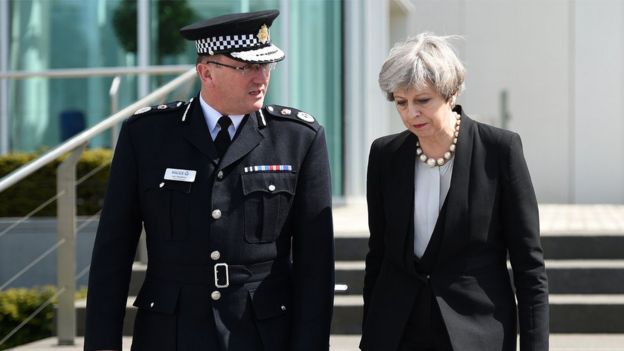
Pic-Chief Constable Ian Hopkins met Theresa May following the 2017 Manchester Arena attack
Crime reporter(wp/bbc):::
About 60% of crimes reported to one of the UK's largest police forces are not fully investigated because of a lack of resources, its chief constable said.
Greater Manchester Police's Ian Hopkins said budget cuts meant officers had to prioritise more ruthlessly than ever.
He said about 600 offences a day, such as thefts from vehicles, were being "screened out" and not pursued because "we don't have enough officers".
The Home Office said it was "committed" to ensuring forces have enough funding.
The number of frontline police officers across England and Wales has fallen over the past decade, while violent crime is rising.
Greater Manchester Police (GMP) said it had lost about 2,000 officers during that time, down to about 6,200.
'Necessary evil'
"If your life is in danger, you've been seriously hurt, we will still turn up," Mr Hopkins told BBC Radio Manchester.
"If there's an immediate threat we will be there and we will be there in numbers.
"If your shed's been broken into, your bike's stolen, your vehicle's broken into and there's no witnesses, there's no CCTV and there's no opportunity for forensics, we'll be screening that out really quickly.
"Your likelihood of a police officer turning up to deal with that is almost non-existent and that's where the public have really started to feel it. That bit worries me."
One of Mr Hopkins' senior officers, Supt Rick Jackson, said screening out crimes was "a necessary evil".
GMP is not the only force to screen reported crimes on the basis of threat and the likely evidence available.
But Mr Hopkins publicly acknowledging the fact that the majority of crimes reported to his force are dropped is thought to be the first time a chief constable has put a figure on this practice.
One man told the BBC he had moved from Manchester to Rossendale in Lancashire after "finally being driven out of the house by crime".
He said: "I was burgled eight times in five years in Cheetham Hill and had vehicles stolen.
"The police would come round and take notes, but they weren't doing anything.
"You could tell by the attitude, there were no forensics done, there was nobody taking in-depth notes and no follow-up."
He said he was left "frustrated and annoyed", adding: "The police are a waste of time."
Bicycle thieves, pickpockets and bag snatchers not found
Police in Greater Manchester did not find a suspect in more than nine out of 10 bicycle thefts, thefts from people or vehicle crimes and in more than eight out of 10 burglaries.
Theft from the person includes bag snatchers and pickpockets but not muggings and robberies.
Data for the year March 2018 to February 2019 also shows that investigations into a quarter of violent and sexual offences were completed with no suspect identified.
The other outcomes, totalling more than four in every 10 recorded crimes, included everything from suspects sent to court to investigations that were not pursued because it was not in the public interest.
The data did not include antisocial behaviour.
Crime in Greater Manchester
Investigations closed with no suspect identified
Last outcome of crimes recorded between March 2018 and February 2019
Source: Police.uk
In 2018, the chief constable of West Midlands Police said budget cuts and falling police numbers meant his force sometimes provided "a poor service".
"We think the public want us to use our time productively and focus our resources where there is greatest harm and where we can secure a positive outcome," a National Police Chiefs Council spokesman said.
Police chiefs have expressed concern about the impact of falling officer numbers on "proactive policing that prevents crime, solves problems and helps people feel safe," he said.
Mr Hopkins said it accounted for about 80% of his budget.
"We've been promised a funding formula review and that hasn't materialised but that needs to happen," he said.
How many police officers are there?
Frontline officers in England and Wales
Note: Figures for 2010 to 2014 are estimates. Excludes officers in support roles.
Source: House of Commons Library "Police Service Strength" report
Increases in council tax, such as that announced in February, which will pay for an extra 320 GMP police officers, "are never going to give Greater Manchester the resources it needs", he added.
The new additions will take the force's strength to about 6,570, compared with 8,219 in 2010.
"The stark reality is that due to years of central government cuts the police simply cannot investigate every crime and have to take difficult decisions about where best to focus their time and resources," said Greater Manchester Deputy Mayor Bev Hughes, who has responsibility for policing in the city region.
"They - and I - wish this were not necessary but unfortunately it is."
Manchester Central MP Lucy Powell said: "It's clear that the government's cuts to police funding is having a real impact on the front line, making it extremely difficult for officers to do their jobs effectively and respond to certain types of crime.
"This should be a wake-up call for ministers who should act to increase resources to tackle crime and disorder."
A Home Office spokeswoman said police funding this financial year would rise by the greatest amount since 2010.
"We recognise the impact crime has on victims and want offenders brought to justice.
"We are committed to ensuring police forces have the resources they need to carry out their vital work," she said.
Finance reporter(wp/reuters)::: The European Union’s system of financial-market access needs adapting to avoid disputes between the EU and Britain over rules after Brexit, a top UK regulator said on Tuesday.
Andrew Bailey, chief executive of the Financial Conduct Authority, said future regulation in Britain will hinge on where the EU system of “equivalence” leads to.
Equivalence refers to Brussels granting foreign banks direct access to customers in the EU if it determines that their home rules are similar enough to those in the EU.
But for this to work after Brexit, it needs a “rules of the game” agreement setting out how equivalence is determined and a mechanism for handling disputes, Bailey said.
Equivalence should be based on whether the outcomes of foreign and EU regulation are the same, rather than on actual rules being written in the same way, Bailey said.
Focusing on outcomes was critical, since Britain has a history of common law and preference for broad principles, while the EU has moved to harmonized rules, Bailey said.
“Left to our own devices, I think the UK regulatory system would evolve somewhat differently,” Bailey said in a speech at Bloomberg.
The EU has said that equivalence was the most likely form of market access for Britain’s financial sector to the EU, its most important customer.
DANGEROUS
Critics say the system is patchy, unpredictable and access can be withdrawn at short notice, citing the four years it took for Europe and the United States to agree on clearing rules.
“We need to be careful here because I would submit that the record to date indicates that all of us are good at talking the language of outcomes but practicing the world of rules,” Bailey said.
Britain’s government has called for “enhanced” equivalence to avoid the UK becoming a “rule taker” or continually copying EU law, but Brussels has shown little appetite for radically overhauling its system.
Some lawmakers want the FCA to have a “competitiveness” remit after Brexit to cut the burden of rules and preserve London’s position as a global financial center, a step that could make equivalence harder to obtain.
Bailey said he was “not convinced” about having a competitiveness remit.
A debate about future relations with the EU was needed as it would be “dangerous” to have equivalence from Brussels without a “rules of the game” pact, Bailey said.
Faced with a major foreign financial center on its doorstep after Brexit, the EU has instead tightened access for foreign clearing houses and investment firms.
Banks, insurers and fund managers in Britain have opted to play safe and open new EU hubs.
Britain has introduced equivalence along with all EU financial rules into national law as part of its Brexit preparations.
The FCA is already fending off pressure for a tit-for-tat response to moves by EU regulators to ban trading of thousands of shares outside the bloc - including leading UK stocks - if there is a no-deal Brexit.
Prime Minister Theresa May’s government is focused on passing the law it needs to ratify Britain’s exit from the European Union, May’s spokesman said on Tuesday.
The spokesman told reporters talks with the Labour Party on finding a way forward on Brexit would require compromise on both sides, and that the legislation could be introduced to make progress with the Brexit process.
Prime Minister Theresa May told her top team of ministers on Tuesday that talks with the opposition Labour Party aimed at finding a way forward on Brexit were serious but difficult in some areas, her spokesman said.
May’s spokesman said there was no specific timetable for the end of talks with Labour, but that the prime minister also told her cabinet that progress was needed to be made urgently to deliver Brexit.
Britain’s competition regulator said on Tuesday it expected to publish its final report on supermarket group Sainsbury’s proposed £7.3 billion takeover of Walmart-owned rival Asda on Thursday, April 25.
The Competition and Markets Authority (CMA) had said in its provisional report in February that the deal, agreed last April, should either be blocked entirely or require the sale of a significant number of stores, or even one of the brands.
The regulator identified 629 areas where there could be a substantial lessening of competition (SLC) in supermarkets, 290 areas where online competition could be reduced and 65 local overlaps in smaller convenience stores.
Sainsbury’s and Asda said last month the CMA’s analysis was “fundamentally flawed” but said they were willing to sell 125-150 stores to get their deal past the regulator - a number well short of what the CMA had said it was looking for.
Given the CMA’s concerns that the combination could lead to higher prices, most analysts and competition lawyers believe it is highly unlikely the deal will proceed.
That expectation has been reflected in Sainsbury’s share price, which has fallen 17 percent over the last three months.
The President of the United States of America, President Donald J. Trump, accompanied by Mrs Melania Trump, has accepted an invitation from Her Majesty The Queen to pay a State Visit to the United Kingdom from Monday 3rd June to Wednesday 5th June 2019.
Notes to Editors
Further details of the State Visit programme will be announced in due course.
President Trump and Mrs Trump previously joined The Queen for tea at Windsor Castle in July 2018.
The Queen has hosted two previous State Visits from Presidents of the United States of America; President George W. Bush and Mrs Bush made a State Visit to the UK in November 2003; and President Barack Obama and Mrs Obama made a State Visit to the UK in May 2011.
Several other Presidents of the United States of America have visited The Queen during Her Majesty’s reign. President Eisenhower paid a visit to The Queen at Balmoral Castle in 1959; President and Mrs Kennedy dined with The Queen and The Duke of Edinburgh at Buckingham Palace in June 1961; President Nixon had lunch with The Queen and The Duke of Edinburgh at Buckingham Palace in February 1969; President and Mrs Reagan made an official visit to the UK in June 1982; President George Bush Snr and Mrs Bush had lunch with The Queen and The Duke of Edinburgh in June 1989; and President and Mrs Clinton visited The Queen in 1995 and in December 2000.
The Queen and The Duke of Edinburgh have made four State Visits to the USA, during Her Majesty’s reign; in October 1957 (President Eisenhower); in July 1976 for the US Bicentennial (President Ford); in May 1991 (President Bush); and in May 2007 (President George W Bush).