Wednesday, 17 May 2017

world's biggest wind turbines go online near Liverpool

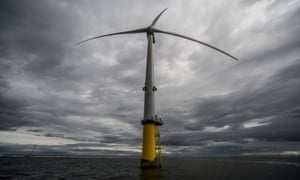
Burbo Bank extension offshore windfarm in Merseyside.
Pic:turbines at the Burbo Bank extension windfarm in Merseyside
Staff reporter(wp):
The planet’s biggest and most powerful wind turbines have begun generating electricity off the Liverpool coast, cementing Britain’s reputation as a world leader in the technology.
Danish company Dong Energy has just finished installing 32 turbines in Liverpool Bay that are taller than the Gherkin skyscraper, with blades longer than nine London buses. Dong Energy, the windfarm’s developer, believes these machines herald the future for offshore wind power: bigger, better and, most importantly, cheaper.
Each of the 195m-tall turbines in the Burbo Bank extension has more than twice the power capacity of those in the neighbouring Burbo Bank windfarm completed a decade ago. “That shows you something about the scale-up of the industry, the scale-up of the technology,” said Benjamin Sykes, the country manager for Dong Energy UK.
The project is the first time the 8MW turbines have been commercially used anywhere in the world, which Sykes hailed as a “very important milestone” for the sector.
Subsidies, friendly regulation and a maritime past have helped the UK install more offshore wind power than any other country in the world. Collectively they now have a capacity of 5.3GW, generating enough electricity to power 4.3m homes. Eight further projects already under construction will add more than half that capacity again.
But ministers have made it clear that the industry must keep cutting costs if the technology, the only large renewable energy source backed by the Conservatives, is to continue earning taxpayer support.
While a recent study showed the cost of offshore wind has fallen a third since 2012, a key litmus test will be the results of a government auction this summer for £290m of renewable energy subsidies.
“I wouldn’t be at all surprised if it comes in below Hinkley,” said Sykes of the prices offshore windfarms might reach, compared to £92.50 per megawatt hour that France’s EDF has been guaranteed for electricity generated by the nuclear power station it is building in Somerset. Previous offshore windfarm subsidy deals have cost well above £100 per megawatt hour.
“This and other projects have been crucial for driving costs down for the whole industry,” said Skyes, pointing to the Burbo Bank extension.
Building fewer but more powerful turbines like these is cheaper because each tower and its blades need a foundation, the “transition piece” that goes atop that, plus the cables to connect it to a nearby substation, and ongoing maintenance.
In Germany, Dong recently made waves when the electricity grid regulator approved its bid to build the world’s first subsidy-free offshore windfarm. While Skyes will not be drawn on when UK windfarms might do the same, he describes this one off Liverpool as “part of the journey to a zero-subsidy windfarm”.
Dong thinks that by the time that German windfarm begins construction, there will be turbines as powerful as 13MW or 15MW. “There’s every reason to think they will arrive,” said Sykes, although he acknowledged eventually they will hit a theoretical limit.
The majority of turbines in UK waters today are between 3.0MW and 3.6MW, with a smattering at 5MW to 7MW, but the Burbo Bank extension is a herald of things to come. Most of the 16 projects which have a planning green light but have not started construction yet will use turbines of at least 8MW.
While the UK benefits from the power from those windfarms, the industry has been criticised in the past for not ensuring enough parts are made in Britain. Dong does not put a figure on what percentage of the Burbo Bank extension is UK built but half the blades are made at MHI Vesta’s Isle of Wight factory; the bits that sit on top of the foundation are built at Teesside.
For people such as Justin Donaghan, the industry also means skilled jobs and a long-term career. The 34-year-old former Royal Navy engineer never saw himself working in green energy before he started working on the original Burbo Bank windfarm seven years ago. He is now a turbine supervisor, looking after the small teams that service the turbines.
“I don’t even think there was a renewable energy sector when I was younger,” he said.

Government accused of ignoring workers' plight as UK faces pay squeeze

Staff reporter(wp):
Labour and the unions accused the government of ignoring the plight of ordinary workers after UK pay growth fell below inflation in early 2017 for the first time in two-and-a-half years.
Official figures showed that workers’ average earnings rose by 2.1% year on year in the three months to March, the weakest increase since July of last year.
With inflation running at 2.3% in the same period, that meant real-terms pay lagged by 0.2% in the first three months of the year, the first fall since the third quarter of 2014.
The Labour party has made weak wage growth one of its main themes in the run-up to the general election on 8 June, which opinion polls suggest Theresa May is on course to win.
Analysis by the Resolution Foundation showed that wages were still £16 a week below their 2008 peak, leaving many families forced to borrow to make ends meet.
John McDonnell, the shadow chancellor, said the figures revealed “the Tories’ total failure to improve the living standards of working families”.
He said: “Real wages are lower than they were in 2010 and, after seven years of the Tories, they are now falling again.”
McDonnell has promised a Labour government would introduce a higher minimum wage and end to a cap on public sector pay rises.
Analysts said Britain was breaking all the rules of the postwar era as record levels of employment and unemployment at a 42-year low failed to spur consistently strong wage increases.
The unemployment rate in the period between January and March fell unexpectedly to 4.6%. Economists polled by Reuters had expected the rate to remain at 4.7%. The number of people in work rose by 122,000, taking the employment rate to a record 74.8%, the Office for National Statistics said.
John Philpott, the director of the JobsEconomist, said: “This is a jobs market that looks better on paper than it feels in the pocket, reflecting a structural shift in the types of work people do and the relative bargaining power between workers and bosses.
“No wonder workers’ rights, productivity and pay rather than the availability of jobs per se, is a key battleground in the UK general election campaign.”
The TUC general secretary, Frances O’Grady, said: “Today’s fall in real wages risks tipping working people into another living standards crisis. And that poses a major challenge for whoever forms the next government.
“The big question for every party is – what’s your plan to get Britain’s wages rising again?”
Liberal Democrat spokesman Vince Cable said:“This squeeze on living standards is almost certainly caused by the falling pound since the Brexit vote.
“If Theresa May is allowed to pursue her extreme Brexit agenda, we can expect further weakening of the economy and erosion of people’s living standards.”
May, who has denied that the Brexit vote lies behind the broader economic slowdown, has said she is aware of the squeeze on household spending and that she will cap energy prices, a move that appears to break with the Conservative party’s usual pro-market stance.
But inflation has already moved up to 2.7% and is heading above 3%, according to many forecasters, adding to the pressure on politicians to act.
The Bank of England is watching for signs of a pickup in wages that could add to inflation. So far it has judged that most of the pressure on shop prices has come from higher import costs that follow a sharp fall in the value of the pound.
Sterling fell by almost a quarter against the dollar after the UK voted to leave the EU before a recovery in recent weeks that has limited to the drop to nearer 13%. 
So far the Bank of England believes there is little pressure on most employers to raise pay sharply, which could feed a more permanent inflation problem.
This week, a survey by the Chartered Institute of Personnel and Development found that most large employers were preparing to raise wages by 1% this year.
Other surveys have shown wage rises softening amid growing numbers of job cuts as Brexit uncertainty affects the labour market.
The Bank of England has softened its previous forecasts for a rise in unemployment, which it expects to stand at 4.7% this year, still above the level it considers inflationary.
The ONS said workers’ total earnings including bonuses rose by an annual 2.4% in the first quarter of 2017, edging up from growth of 2.3% in the three months to February.
The Bank expects wages to rise by 2% this year before picking up in 2018 and 2019, though it has forecast a stronger outlook in all of the last seven years only to be proved overly optimistic.
The ONS said the number of unemployment benefit claimants rose by 19,400 to just under 793,000 in April, slower than an increase of 33,500 in March.

Monday, 15 May 2017

Business leaders want next government to build two more runways

Business reporter(wp):
Business leaders have called for the next government to build two more runways, demanding that a follow-up Airports Commission be established only months after Heathrow’s third runway was approved.
The Institute of Directors urged that a fast-track commission be set up immediately after the election to recommend locations for two additional runways within a year. The controversial expansion of Heathrow has yet to be finally voted through parliament, almost five years after the first Airport Commission was established by David Cameron, and is not expected to be completed before at least 2025.
The IoD, which represents 30,000 UK company directors, said that the commission had underestimated demand for air travel and said Gatwick would also be full before Heathrow, Britain’s main hub airport, was enlarged. Almost 45 million passengers travelled through Gatwick in the last year, a 9% increase.
Dan Lewis, senior infrastructure adviser at the Institute of Directors, said: “The growth in passenger numbers is far ahead of what the Airports Commission said it would be. This is a fast-moving target.
“Whoever wins the next election, they will face a serious challenge in upgrading the UK’s transport and communications network. The years of dawdling on new airport capacity have left us lagging well behind European competitors. Expanding Heathrow is not enough.”
Plans for a third Heathrow runway were cancelled by the coalition in 2009, before renewed pressure from business groups, the aviation industry and backbench MPs pushed the prime minister to reopen the issue of airport expansion. Sir Howard Davies’ commission said only one runway could be built before 2030 within Britain’s climate change obligations.
The London Chamber of Commerce and Industry has also called for the next government to enable a second runway at Gatwick to help create a “megacity”. While Gatwick was shortlisted as a candidate for a new runway, other airports such as Stansted and Birmingham would be likely to push hard should a future opportunity emerge.
A Heathrow spokesperson said: “We’re getting on with expanding Britain’s only hub airport – with the new runway on track to open in 2025, doubling cargo capacity and adding 50% more flights. Heathrow continues to support the growth of aviation capacity in the UK in line with strict environmental targets.”
John Stewart, chair of anti-Heathrow expansion group Hacan, said the IoD was “living in a fantasy world”. He added: “Because of the opposition, it takes years to build one runway. To try to build three at a time would create a nationwide network of opposition from local resident groups and climate change activists, the likes of which the UK has not seen before.”
The IoD also urged a roadmap for building Crossrail 2, the north-south rail line that Transport for London has insisted will be crucial to meet the needs of the capital, particularly once HS2 is operational.
Although it was identified by the National Infrastructure Commission as the single most important project for development, the preferred route has yet to be published by the transport secretary, Chris Grayling, and political impetus for the rail line appears to have diminished. Lewis said: “Since Theresa May took over, it’s back-pedalled a bit. Certainly there’s a sensitivity about it looking like a London project – but you can’t ignore the national importance.”
In a manifesto paper, the business group said that the government should also prioritise ultrafast broadband and 4G coverage. Lewis said: “Ultrafast broadband could mean a rural economy renaissance, it could drive growth and make places with low land values good economic prospects.” The IoD said that there should be a commitment to switching from copper to fibre networks by 2025.
Labour’s leaked manifesto has backed superfast broadband for every home by 2022.

Labour and Tories to woo working-class voters with new policies

Political reporter(wp):
Labour and the Conservatives are to intensify their bidding war for working-class voters with a number of eye-catching policies on workers’ rights and the NHS, as the general election campaign steps up a gear with just over three weeks to go until polling day.
Jeremy Corbyn will promise on Monday to take a million patients off NHS waiting lists by 2020 and Theresa May will announce what she claims is the biggest extension of workers’ rights by any Conservative government, as the parties compete for the backing of what the prime minister calls “ordinary working-class people”.
Corbyn will address an audience of 3,000 nurses on Monday at the annual Royal College of Nursingconference in Liverpool, where he will promise that Labour will spend an extra £37bn over the next parliament on a “new deal” for the NHS.
The party calculates the sum would allow the NHS to take a million people off waiting lists by the end of this parliament by guaranteeing access to treatment within 18 weeks, and to ensure that patients could always be seen in A&E within four hours.
The Labour leader will repeat the party’s pledge to lift the 1% pay cap for public sector workers that has restrained nurses’ wages. He will tell nurses, who voted on Sunday to ballot for strike action over pay: “Imagine what would happen to the NHS if the Conservatives under Theresa May were to have another five years in power. It would be unrecognisable: a national health service in name, cut back, broken up and plundered by private corporations.”
May will spend Monday morning at a workplace in south-east England, where she will announce plans for new statutory rights to unpaid leave for carers and bereaved parents, fresh protections for workers with mental illness and safeguards against pensions mismanagement. Workers will be allowed to take up to 12 months’ unpaid leave to care for family members with an illness or disability under the proposals.
The pledges are the latest step in the prime minister’s strategy of rebranding the Tories as the party of working people in an attempt to seize seats across a swath of traditional Labourterritory.
The Conservatives will also commit to increase the “national living wage” each year in line with average earnings over the course of the next parliament. That is likely to be significantly less generous than Labour’s pledge to raise the minimum wage for all workers, not only the over-25s, to £10 an hour.
Many of the Tory proposals are likely to be regarded by the right of May’s party as imposing burdensome red tape on businesses, but May has openly rejected the laissez-faire approach of David Cameron, urging Conservative members in her party conference speech last October to “put the power of government squarely at the service of ordinary working-class people”
The Conservatives know some of Labour’s tax-and-spending pledges poll well, after almost a decade of austerity. But they are hammering home the message that Labour’s sums do not add up and are relying on other levers, such as new rules and regulations, to show they are on the public’s side.
Labour’s promised boost to NHS funding includes £10bn for extra capital investment, including in IT systems, which were subject to a damaging cyberattack on Friday. This would be funded through borrowing, while the rest of the new spending would be paid for by tax increases, including higher income tax for the top 5% of earners.
Labour’s shadow health secretary, Jonathan Ashworth, said the “substantial amount” of extra NHS funding would come from higher income tax on those earning above £80,000.
“We are being entirely upfront that people above £80,000 will pay more tax under a Labour government,” he told BBC Radio 4’s Today programme on Monday. “And we believe that every penny piece that is raised from that tax will go into our National Health Service.”
There would be an extra £10bn for capital spending from the planned £250m capital investment fund, and some more from corporation tax, Ashworth added.
All would be revealed in the full manifesto, he said: “I think that the IFS [Institute for Fiscal Studies] and others will be reassured when they see [shadow chancellor] John McDonnell’s sums tomorrow.”
A Conservative spokesman said: “Jeremy Corbyn can’t deliver any of this because his nonsensical economic policies would damage our economy and mean less money for the NHS, not more.”
As well as announcing new workers’ rights, May will repeat her promise to maintain all of the protections currently underpinned by the EU, which include maternity leave and paid holidays.
Damian Green, the work and pensions secretary, said the workplace changes would also see employees offered a voice on company boards, though he said this would not necessarily be a staff representative.
He denied this amounted to a climbdown on what May had promised when she stood for the Tory leadership in July, a plan from which she later backed away.
“We haven’t watered it down at all,” Green told Today. “What we are saying today, we actually said in the green paper we put out about this idea. What Theresa said when she when she first brought this up during the leadership election campaign last year was that there needs to be a worker’s voice on board.”
This could be one of three things, he said – a worker on the board; a non-executive director representing staff, or some form of workers’ advisory board.
Frances O’Grady, the general secretary of the TUC, told the WP the real test of May’s pledge to govern for working people would be whether she was willing to write such protections into the trade deal Britain signs with the rest of the EU after Brexit.
O’Grady, who represents almost 6 million union members, said the Conservative manifesto should include a clear promise to ensure Brexit was not used as an excuse for a “race to the bottom”. In particular, she said, she would like to see the final Brexit deal include a promise not to undercut European social standards.
“This is not about sovereignty; this is about saying there will be a level playing field and nobody will fall below this basic standard,” she said.
“Now, of course, Theresa May has already said that she won’t just protect rights, she will enhance them – so it should cause no problem whatsoever for the Conservative party to sign up to a commitment that British workers will not fall behind rights in other countries.”
That idea has already been included in plans for the talks by the EU’s chief negotiator, Michel Barnier, after lobbying from trade unions. The European council’s negotiating guidelines say of any future trade deal with the UK: “It must ensure a level playing field, notably in terms of competition and state aid, and in this regard encompass safeguards against unfair competitive advantages through, inter alia, tax, social, environmental and regulatory measures and practices.”
The prime minister is expected to promise to enhance protections for workers in the gig economy, whose precarious status has become a focus after a series of investigations, including by the Guardian, revealed that many survive on poverty pay rates, with little or no job security.
However, the Conservative manifesto is not expected to give details of fresh rights, instead promising to await the findings of a review into the 21st-century workplace being carried out by a former adviser to Tony Blair, Matthew Taylor.
O’Grady said: “I don’t think it’s going to be good enough at this stage to talk about reviewing things or developing things. I don’t think that’s going to cut much ice.”
As well as Corbyn, the RCN conference in Liverpool will hear from the Liberal Democrat leader, Tim Farron, who will echo Corbyn’s pledge to lift the ceiling on public sector pay.
The Lib Dems’ Treasury spokesman, Vince Cable, said: “Public sector workers are facing a double blow at the hands of this Conservative government, with years of pitiful increases to pay combined with a Brexit squeeze caused by soaring inflation. Living standards are falling, prices are rising and nurses are going to food banks – but Theresa May doesn’t care.”

Sunday, 14 May 2017

Man fighting for life after being knifed in head near murder scene

Crime reporter(wp/es):
A man is fighting for life after he was stabbed in the head just yards from a murder scene in north London.
Police rushed to Southbury Road in Enfield on Sunday at 2pm after reports a man was injured near a Tesco car park.
Paramedics also arrived and London’s Air Ambulance landed nearby.
They found a man in his 20s suffering from stab wounds to his head and leg.
He was taken to an east London hospital where he remains in a life threatening condition.
A Scotland Yard spokesman said: “At this stage officers believe that the man was stabbed following an altercation with a group of males in Exeter Road.
“The victim was placed in a vehicle by friends who attempted to seek help.
“The vehicle stopped in Southbury Road where the emergency services were called.”
The crime scene was minutes from Hertford Road, the scene of a triple stabbing on Saturday night that saw an 18-year-old die and left two other youths injured.
No arrests have been made over Sunday’s attack.

Man shot and stabbed in broad daylight east London attack

Crime reporter(wp/es):
A man who died after a broad daylight attack in east London was shot and stabbed, police say.
Emergency services rushed to the scene in Eagling Close, Bow, just before 4.30pm on Saturday where the 41-year-old man was lying injured.
Paramedics, including those from the Air Ambulance, battled to save his life but he was pronounced dead at the scene just over an hour later.
Detectives revealed on Sunday they believe the man was both shot and stabbed.
Police are now looking for anyone who may have seen what happened, including a woman wearing pink trousers who was spotted in the area.
Detective Chief Inspector Gary Holmes, from the Met’s Homicide and Major Crime Command said"This was a violent murder that happened in broad daylight on a Saturday afternoon.
"There will be witnesses who have yet to speak with police who may have seen something significant.
“I want to hear from anyone with information, and in particular from anyone who may have seen or heard anything suspicious between around 4.20pm and 4.40pm in the area of Eagling Close.
He added: "I am aware of a white female wearing pink trousers who was seen in Eagling Close around the time of the murder.
“Even if she doesn't think she saw anything significant, it is vital that this person makes contact with police."
Two men have been arrested over the killing and remain in custody at east London police stations.
The latest attack came just a day after the WT launched an investigation into the capital's knife crime epidemic, with 11 Londoners killed in just 16 days.

Final taxpayer shares in Lloyds Banking Group to be sold off

Business reporter(wp):
The government is expected to sell off its remaining shares in Lloyds Banking Group in the coming week, marking a watershed moment for the sector after the financial crisis.
Eight years after pumping in £20bn to prevent the bank from collapsing, taxpayers will no longer own any shares in an institution that was created in the depths of the financial crisis when Lloyds TSB rescued HBOS.
The share sale, in the midst of the general election campaign, will highlight the contrast between the progress of Lloyds and that of Royal Bank of Scotland, which is still 73% owned by the government and has yet to make an annual profit since its bailout.
At its peak, the taxpayer holding in Lloyds stood at 43% and first started to be scaled back in September 2013. Last week, the bank’s chairman, Lord Blackwell, told shareholders at its annual general meeting that the stake had fallen to 0.25%, with those final shares expected to be disposed of in the coming days.
They will not be sold with the fanfare envisioned by George Osborne when he was chancellor. He had ambitions for a discounted share sale to the public, which had to be abandoned a year later by his successor, Philip Hammond, because of the fall in the bank’s shares after the Brexit vote.
Instead the shares are being sold off on the stock market through the investment bank Morgan Stanley at prices below the 73.6p average that taxpayers paid during the three-stage bailout that began in January 2009.
Hammond has said that despite some of the shares being sold at a loss, the government has still recouped all the £20.3bn used to buy shares. However, that does not take into account the £3.6bn cost incurred by the government although the bank’s chief executive, António Horta-Osório, told last week’s AGM that the government would make at least £500m from the bailout.
The return to the private sector has led to 57,000 job cuts – in part because of cost-cutting implemented in the merger but also subsequent efficiency drives to boost profitability.
The bailout also required a restructuring of the bank. While a competition inquiry was averted after the HBOS deal was clinched at the height of the crisis, the EU required 600 branches to be sold off. Those TSB branches are now owned by Sabadell of Spain. Lloyds still has a 25% share of current accounts, 22% of retail deposits and 21% of the mortgage market, largely through Halifax.
The recovery of Lloyds has also been held back by a bill of more than £17bn to compensate customers missold payment protection insurance (PPI) – about half the industry’s total.
Horta-Osório, who has been paid more than £30m since becoming chief executive in 2011, will now face questions about his own plans. He has focused the bank on the UK, which now accounts for 97% of its business, after retreating from 30 countries to six.
The Portuguese banker is also expanding into credit cards, buying MBNA for £1.9bn to increase Lloyds’ market share from 15% to 26%, at a time when concerns are being raised about the speed of consumer credit growth.
Horta-Osório is also facing anger from businesses hit by the loans scam at the HBOS branch in Reading. Six people were jailed in February after a jury heard they splashed out on superyachts and sex parties, while destroying businesses they had been lending to. Lloyds has set aside £100m to compensate 64 victims including the TV presenter Noel Edmonds but is facing questions about whether it will be enough.

Timeline

September 2008 A £12bn takeover of HBOS by Lloyds TSB comes just days after the collapse of Lehman Brothers sent shockwaves through financial markets. The Financial Services Authority, then the City regulator, says the deal will “enhance finance stability”.
October 2008 As financial instability mounts the government announces a bailout of the banking system. Lloyds TSB renegotiates the takeover of HBOS to 0.605 Lloyds TSB shares for every one HBOS share, from 0.833 a month earlier.
January 2009 Lloyds Banking Group is created from the purchase of HBOS by Lloyds TSB. The government begins first of a three-tranche bailout of the group, pumping in £13bn.
May 2009 Sir Victor Blank is forced to step down as chairman of Lloyds.
June 2009 The government puts in another £1.5bn.
December 2009 The government backs cash call, buying £5.8bn of shares. Total rescue deal amounts to £20.3bn. Taxpayer stake stands at 43%.
March 2011 Eric Daniels leaves and António Horta-Osório takes over as chief executive.
May 2011 Lloyds takes first provision for payment protection insurance of £3.2bn. The bank’s bill eventually tops £17bn.
November 2011 Horta-Osório takes leave, citing fatigue. He returns to work in January.
September 2013 The taxpayer stake gradually reduces from 43% to 39% for technical results. It is cut to 33% when a formal sell-off of Lloyds shares begins: £2.3bn of shares sold to big City investors at 75p a share.
March 2014 £4.2bn of shares sold at 75.5p, taking the taxpayer holding to 24%.
February 2015 Dividends to resume for first time since the bailout.
December 2014 George Osborne announces a plan to dribble out shares into the market.
October 2015 Osborne unveils plans for a cut-price sale to the public.
October 2016 Philip Hammond, the new chancellor, abandons his predecessor’s pledge to sell cut-price shares to the public.
May 2017 The taxpayer is expected to exit Lloyds Banking Group.