Monday, 13 May 2019

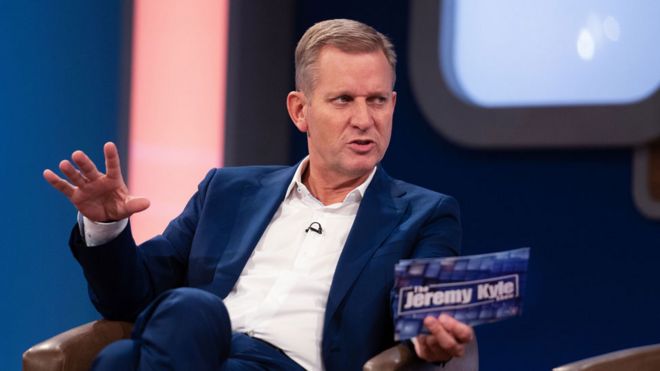
Jeremy Kyle Show suspended after guest death

Jeremy Kyle
Entertainment reporter(wp/bbc):::
ITV has suspended The Jeremy Kyle show after a guest died shortly after filming, and is conducting a review into the episode "given the seriousness of this event".
The broadcaster took Monday's show off air and replaced it with a repeat of Dickinson's Real Deal.
The participant from the episode died a week after recording it.
ITV said everyone at the show is "shocked and saddened" and "thoughts are with the family and friends".

DNA tests and lie detectors

It will not screen the episode and said both filming and broadcasting were suspended with "immediate effect".
The show has been broadcast in its mid-morning slot since 2005. Its guests discuss relationship issues and conflicts with each other in front of Kyle's studio audience.
It is well-known for its often heated debates, with Kyle mediating between guests.
The show's website asks for participants to contact the programme to discuss issues involving DNA and lie detector tests, fighting with an ex over access to a child, feuding families, break-ups, relationship problems, bad parents, addictions, and reunions.
It is the most popular show on ITV's daytime schedule, with an average of one million viewers and a 22% audience share.
The show had been due to screen an episode with troubled ex-EastEnders star Danniella Westbrook as its guest on 14 May.

Further Brexit delay would hit UK economy - BoE's Broadbent

 Business&Economy(wp/reuters):::
Britain’s economy risks damage if Brexit is delayed beyond its latest Oct. 31 deadline because companies would continue to hold back on investment, Bank of England deputy governor Ben Broadbent was quoted as saying on Monday.
“It’s pretty clear that investment has been feeling the consequences of the uncertainty about Brexit and particularly the possibility of a bad outcome,” Broadbent told the Press Association news agency.
“If you continually expect news to arrive imminently - a resolution - then that can have quite a depressing effect on investment,” he said.
By contrast, a Brexit deal would lead to “quite a strong bounce-back in investment.”
Broadbent reiterated the BoE’s guidance that future interest rate increases would be limited and gradual, adding the “emphasis is on the ‘gradual’ bit of limited and gradual.”
He said he did know whether the British central bank would need to increase rates or cut them in the event of a no-deal Brexit shock to the economy.
“I don’t know. I really don’t, because I don’t know how much the exchange rate will move,” he said.
Several other top BoE officials, including Governor Mark Carney, have said a rate cut would probably be needed to help the economy weather the shock of leaving the European Union with no deal.
On whether he will put his name forward as a candidate to succeed Mark Carney as BoE governor, Broadbent said: It’s a big job...I have lots of things to think about before I make that decision.”

Brexit: Cross-party deal must include confirmatory vote - Sir Keir Starmer

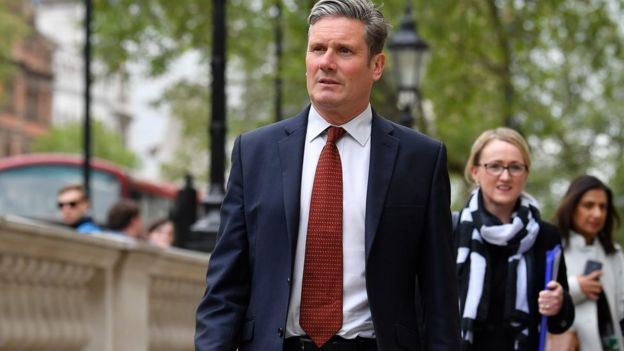
Sir Keir Starmer
Pic-Sir Keir Starmer is leading Labour's negotiations with the government/AFP
Political reporter(wp/bbc):::
A cross-party Brexit deal will not get through Parliament unless it is subject to a fresh public vote, shadow Brexit secretary Sir Keir Starmer says.
Talks between Labour and ministers over leaving the EU have been going on for a month with little sign of progress.
Sir Keir told the Guardian that without a new referendum, up to 150 Labour MPs would vote against any agreement made.
Foreign Secretary Jeremy Hunt said it was a "crunch week" for the talks ahead of European elections on 23 May.
He said his view had not changed that another referendum would be a "betrayal" and everyone's focus should be on delivering on the result of the 2016 Brexit vote.
The UK was due to leave the EU on 29 March, but the deadline was pushed back to 31 October after MPs rejected Theresa May's proposed deal three times.
Talks between the government and Labour aimed at finding a way out of the impasse will resume at 17.00 BST with pressure growing on both sides to show progress or pull out.
No 10 said there was a "clear desire" to get on with the process. Asked if there was a deadline, a spokesman said "let's see where we get to this evening".
If there is no agreement, Theresa May has said she will return to Parliament and ask MPs to vote again on a range of possible options.
Parliament failed to unite behind a way forward in a series of "indicative votes" in March, but the PM says the government would now be prepared to accept whatever commands a majority if Labour does so too.
Sir Keir said he would not be afraid to end the talks as soon as this week if the prime minister did not budge on her so-called red lines - positions that she feels cannot be changed in the Brexit deal.
He suggested a referendum on the final deal had become a red line of its own for many Labour MPs, saying "a significant number, probably 120 if not 150, would not back a deal if it hasn't got a confirmatory vote".
Labour's stated policy is that it supports a further referendum on Brexit under certain circumstances.
It has rejected the idea of campaigning for one in any event, but will demand a public vote if it cannot get changes to the government's deal or an election.
However, deputy leader Tom Watson agreed that with so many of his fellow MPs wanting to give the public the final say, it would be very difficult to "enforce" any Brexit agreement without another vote.
"This will only work if two very strongly-held views are plugged together - Theresa May's deal and a confirmatory ballot," he told Radio 4's Today. "That is the way out of this."
Asked whether Labour wanted to leave or remain in the EU, he replied: "We are a remain and reform party," but "when it comes to a deal people can form their own view".
In a speech later marking the 25th anniversary of former Labour leader John Smith's death, Mr Watson will reflect on Mr Smith's pro-Europeanism and say he would have backed a "People's Vote".
On the European elections, he will say: "There are only two forces that can win... that nasty nationalism of the Farage Brexit Party, or the tolerant, compassionate outward-looking patriotism of the Labour Party.
"I can only plead with Labour supporters - don't stay at home, don't put that cross elsewhere, don't let them win."
The reality is these talks have been genuine, but very difficult.
Neither side wanted to pull the plug before the local elections 10 days or so ago.
But now, as time goes on, it may well be we are reaching the moment where they have to throw up their hands and say: "We just can't do it."
Jeremy Corbyn and Theresa May are both on lonely tightropes trying to get across the other side of this slow-moving crisis. I think they would both like it to be over with, maybe with a cross-party deal.
But the prime minister doesn't want to put a huge compromise on the table, she doesn't want another referendum. Jeremy Corbyn doesn't want to help out the government unless he can get genuine changes.
If neither of them feel they can really budge, well, the talks are not going to be able to succeed, and the government will then have to try to move on to votes in Parliament, the next part of the process.

Speaking ahead of a meeting of EU foreign ministers in Brussels, Mr Hunt said people voted in good faith in 2016 in the belief the result would be acted upon.
"People have been pessimistic right from the outset that these negotiations were not going to get anywhere but they have continued," he said.
"So we have to see what happens this week. This is a crunch week."

Labour's position on Brexit

June 2017 - Labour's general election manifesto accepts referendum result
March 2018 - Shadow Northern Ireland secretary Owen Smith sacked for supporting second referendum on final deal
September - Labour agrees if a general election cannot be achieved it "must support all options… including a public vote"
18 November - Labour leader Jeremy Corbyn says a new referendum is "an option for the future" but "not an option for today"
28 November - Shadow chancellor John McDonnell says Labour will "inevitably" back a second referendum if unable to secure general election
16 January 2019 - 71 Labour MPs say they support a public vote
6 February - Mr Corbyn writes a letter to Mrs May outlining five changes with no mention of a "People's Vote"
28 February - Labour says it will back a public vote after its proposed Brexit deal is rejected
14 March Five Labour MPs quit party roles to oppose a further referendum
27 March - The party backs a confirmatory public vote in Parliament's indicative votes on a way forward for Brexit
30 April - Party agrees to demand a public vote if it cannot get changes to the government's deal or an election, as it decides wording to EU election manifesto
May's party slumps to fifth place as pressure mounts for her to go

Political reporter(wp/reuters):::
Prime Minister Theresa May’s Conservatives have fallen to fifth place in an opinion poll ahead of the May 23 European parliamentary election as pressure grows for her to set a date for her own departure.
Nigel Farage’s Brexit Party was in the lead, up four percentage points, on 34% while May’s Conservative Party had just 10%, the YouGov poll for the Times newspaper showed. The opposition Labour Party was down five points on 16%.
Two parties which support staying in the EU, the Liberal Democrats and the Greens, were on 15% and 11% respectively.
The collapse in support for the Conservative Party is piling pressure on May to set a date for her departure. Senior Conservatives want May to set out her plans this week.
Nearly three years since the United Kingdom voted 52% to 48% to leave the European Union, there is still no agreement among British politicians about when, how or even if the divorce should take place.
“The reason I am back today doing what I am doing is because frankly we’ve been betrayed by our career political class,” Farage told TalkRadio.
“If the Brexit Party comes out on top in a couple of weeks time, we must have a place at the negotiating table with the government to help put together our strategy.”
Britain was due to have left the European Union on March 29, though May has been unable to get her divorce deal approved by parliament so she has turned to the Labour Party, led by socialist Jeremy Corbyn, in a bid to court his support.
Labour’s Brexit pointman, Keir Starmer, told The Guardian newspaper that any cross-party deal lacking a confirmatory referendum would not pass parliament as about 150 Labour lawmakers would oppose such a deal.

MAY CLARITY

May, who secured the leadership in the chaos that followed Britain’s 2016 vote to leave the European Union, has promised to step down if lawmakers back the deal she struck with Brussels to leave the bloc.
But the prime minister has lost heavily on three attempts to get it through parliament.
Graham Brady, chairman of the 1922 Committee, which can make or break party leaders, said that May had been asked to give “clarity” about her future at a meeting this week.
The new deadline for leaving the EU is Oct. 31 though many Brexit supporters fear that the whole divorce could be derailed.
“We are at real risk of sleepwalking into remaining in the EU,” Brexit Secretary Steven Barclay wrote in the Sun newspaper.
“That is why I believe that it would be inexcusable for the Government to not use the coming months to continue to prepare for the real risk we leave the EU without a deal.”
He later wrote in Twitter that in a choice between a no-deal exit or staying in the EU, he would vote to leave without agreement.

Sunday, 12 May 2019

Organised crime 'chronic and corrosive' to the UK - National Crime Agency

Sr'Crime reporter(wp/bbc):::
The threat of organised crime is "chronic and corrosive" to the UK and more money is needed to tackle it, according to the National Crime Agency.
Head of the agency, Lynne Owens, said organised criminals were killing more citizens per year than terrorism, war and natural disasters combined.
She said offenders took advantage of the ever-changing face of technology to dominate local communities.
The NCA is calling for "significant new investment" to combat organised crime.
On Tuesday, the agency will launch its annual national strategic assessment (NSA), which exposes how organised criminals are exploiting advances in technology.


Adopting new methods, and using these alongside old-style violence, organised criminals "Against a backdrop of globalisation, extremism and technological advances, serious and organised crime is changing fast and law enforcement needs significant new investment to help combat it," Ms Owens said.
"This is the most comprehensive assessment we have ever produced and describes in detail the growing and ever-changing nature of the threat posed by serious and organised crime - to individuals, to communities and to wider society."
The NSA draws on information and intelligence from sources across law enforcement, as well as many public and private sector organisations, the NCA said.
The NCA is the agency charged with apprehending those who pose the most serious risk to the UK.commit a multitude of crimes, dominate communities and chase profits, the NSA will show.

Cricket - Buttler blasts century as England edge Pakistan in run-fest

Sports reporter(wp/reuters):::
England batsman Jos Buttler smashed an unbeaten 110 off 55 balls as the hosts beat Pakistan by 12 runs in a thrilling run-packed second one-day international on Saturday.
Buttler’s blitzkrieg and half-centuries by Jason Roy, Jonny Bairstow and skipper Eoin Morgan helped England to a huge total of 373 for three wickets in 50 overs.
Pakistan, who made their best ever score when chasing in ODIs, fell short despite Fakhar Zaman’s superb 138 as the hosts took a 1-0 lead in the five-match series after the first game was washed out.
Asked to bat first on a flat pitch, England laid a solid platform for Buttler to build on, with Roy scoring 87 and Bairstow 51 in a 115-run opening partnership.
Joe Root fell for 40 following a brief rain interruption, bringing Morgan and Buttler together and the pair put on 162 for the fourth wicket with the captain contributing an unbeaten 71 off 48 balls.
Buttler did most of the big hitting, smashing nine sixes and six fours en route to his eighth ODI century and getting there with a fierce hit over the ropes which the new father celebrated by rocking his bat in his hands.
But Pakistan, whose previous highest score batting second was 344-8 in a loss to India in 2004, were not giving up without a fight.
Zaman took the attack to the bowlers, hitting four sixes and 12 fours before he was caught by Buttler off Chris Woakes to leave Pakistan at 227 for two.
Fifties from Babar Azam and Asif Ali and captain Sarfraz Ahmed’s unbeaten 41 took Pakistan close to their target but England hung on for the win as they continue preparations for the World Cup on home soil starting later this month.
Meanwhile, Ireland, who did not qualify for the World Cup, scored 327 for five in 50 overs in a five-wicket defeat by twice champions West Indies in Dublin.
Ireland’s Andy Balbirnie hit 135 to give his team a chance of an upset but the West Indies prevailed with their highest successful chase in ODIs thanks to Sunil Ambris’s 148.

Britain's Conservatives in fourth place in EU election poll, Farage leads

Political reporter(wp/reuters):::
Theresa May’s Conservative Party has fallen into fourth place in a poll on voting intentions for the European elections, well behind Nigel Farage’s new Brexit Party which has more support than Britain’s traditionally two biggest parties combined.
According to the latest Opinium poll for the Observer newspaper, Farage’s newly formed party is on 34% of the vote ahead of the May 23 election that is being held because Britain failed to leave the European Union as expected in March.
The poll put Labour in second place on 21% while the prime minister’s Conservatives are back in fourth on 11%. The pro-EU Liberal Democrats, the most popular party to explicitly call for a second referendum to reverse Brexit, are on 12%.
Britain’s two biggest parties endured a drubbing at the polls this month when voters expressed their frustration with the Brexit deadlock at local elections.
Farage, whose former party UKIP is credited by many with forcing Britain’s 2016 referendum on EU membership, launched his new party in April, threatening to take on Britain’s political leaders who he accused of betraying the vote to leave.
May has been forced to open talks with the opposition Labour Party to find a compromise on Brexit after lawmakers heavily rejected her EU withdrawal deal three times.
Britain is now due to leave the bloc in October but with parliament split over the terms, it remains unclear how or whether it will.