Sunday, 21 July 2019

Royal Society medal, award and prize winners-->2019/20

Royal Society awards, medals and prizes
The Royal Society has announced the winners of 24 medals and awards. The annual prizes recognise exceptional researchers who make outstanding contributions to science.
Sir Venki Ramakrishnan, President of the Royal Society, said:

“The Royal Society gives an array of medals and awards to scientists who have done exceptional, ground-breaking work. This year, it is again a pleasure to see these awards bestowed on scientists who have made such distinguished and far-reaching contributions in their fields. I congratulate and thank them for their efforts.”

Royal medals

Dame Carol Robinson DBE FMedSci FRS receives the Royal Medal for her pioneering work on structural biology improving the understanding of proteins, their interactions and functional regulation. The Royal Medals are one of the Royal Society’s premier awards and are made on behalf of the Queen each year. Awarded annually since 1825, this year’s recipients of the Royal Medals join the ranks of Fred Sanger, Francis Crick, and Mary Lyon.
Dame Carol Robinson DBE FMedSci FRS said:

“I am truly delighted to be acknowledged with this award. Over the years, I have watched a number of Royal Society Medal Award ceremonies and have always been very impressed by the recipients. I am delighted to be joining this distinguished crowd.”
Also receiving the Royal Medal is Dr Michel Goedert FMedSci FRS for identifying and characterising key molecules and showing that they form the inclusions of Alzheimer’s and Parkinson’s diseases.
Dr Michel Goedert FMedSci FRS said:
“I am honoured to receive the Royal Medal and feel humbled when I read the list of previous recipients. My work on neurodegenerative diseases would not have been possible without the support of Aaron Klug, the international culture of the MRC Laboratory of Molecular Biology and the contributions of a number of close collaborators.”
Dame Ann Dowling OM DBE FREng FRS received the third and final Royal Medal for her leading research on the reduction of combustion, aerodynamic noise and the design of aircraft, and her distinguished services to engineering.
Dame Ann Dowling OM DBE FREng FRS said:
“I am surprised, delighted and very honoured to be awarded the Royal Medal and it is humbling to see the previous recipients. I have been lucky to work with some brilliant colleagues and students and this award recognises their achievements as much as it does mine.”

Croonian Medal

The Croonian Medal and Lecture is awarded to Professor Edward Boyden for his inventions that expand our understanding of the brain and allow therapeutic development including the co-invention of optogenetics, a technology that has revolutionized neurobiology.

Bakerian Medal

Sir James Hough OBE FRS is awarded the Bakerian Medal and Lecture for his world-leading work on suspensions systems for the test masses used in laser interferometry, pivotal to the successful detection of gravitational waves.

Sylvester Medal

The Sylvester Medal is awarded annually for an outstanding researcher in the field of mathematics, this year to Professor Peter Sarnak FRS for transformational contributions across number theory, combinatorics, analysis and geometry.

Rosalind Franklin Award

The Royal Society Rosalind Franklin Award is awarded annually to those who raise the profile of women in STEM in their host institution and/or field of expertise in the UK. This year it is awarded to Professor Nguyen Thi Kim Thanh, Professor of Nanomaterials at the University College London, for her achievements in the field of nanomaterials and her impactful project proposal.

The full list of winners is available below:

Premier Awards

Copley Medal (announced in May 2019)
Professor John Goodenough ForMemRS in recognition of his exceptional contributions to the science and technology of materials, including his discovery that led to rechargeable lithium batteries.
Royal Medals
Dame Carol Robinson DBE FMedSci FRS
For her pioneering work on structural biology improving the understanding of proteins, their interactions and functional regulation.
Dr Michel Goedert FMedSci FRS
For identifying and characterising assembled tau protein and alpha-synuclein and showing that they form the inclusions of Alzheimer’s and Parkinson’s diseases.
Dame Ann Dowling OM DBE FREng FRS
For her leading research on the reduction of combustion, aerodynamic noise and the design of aircraft, and her distinguished services to engineering.
Croonian Medal and Lecture
Professor Edward Boyden
For his inventions that expand our understanding of the brain and allow therapeutic development including the co-invention of optogenetics, a technology that has revolutionized neurobiology.
Bakerian Medal and Lecture
Sir James Hough OBE FRS
For his world-leading work on suspensions systems for the test masses used in laser interferometry, pivotal to the successful detection of gravitational waves.

Medals

Buchanan Medal
Professor Gillian Griffiths FMedSci FRS
For establishing the fundamental cell biological mechanisms that drive cytotoxic T-cell killing, laying the foundations for informed application of cancer immunotherapy.
Darwin Medal
Professor Peter Holland FRS
For his work with many organisms and genes elucidating key aspects of how changes in the genome influence evolution of animal development.
Davy Medal
Professor Varinder Aggarwal FRS
For his ground-breaking methods coupling boronic esters creating 3-D architectures with full control over shape and functionality with broad ranging applications across the sciences.
Gabor Medal
Professor Alison Noble OBE FREng FRS
For developing solutions to a number of key problems in biomedical image analysis and substantially advancing automatic extraction of clinically useful information from medical ultrasound scans.
Hughes Medal
Professor Andrew Cooper FRS
For the design and synthesis of new classes of organic materials with applications in energy storage, energy production and energy-efficient separations.
Leverhulme Medal
Professor Frank Caruso FRS
For driving the application of engineered particles in biology and medicine through nanoscale materials engineering.
Rumford Medal
Professor Miles Padgett FRS
For world leading research on optical orbital momentum including an angular form of the Einstein-Padolsky-Rosen paradox.
Sylvester Medal   
Professor Peter Sarnak FRS
For transformational contributions across number theory, combinatorics, analysis and geometry.

Prize lectures

The following medals are also awarded an associated prize lecture, which will be delivered at the Royal Society in London:
Clifford Paterson Medal and Lecture
Dr Jacqueline Cole
For the development of photo-crystallography and the discovery of novel high-performance nonlinear optical materials and light-harvesting dyes using molecular design rules.
Ferrier Medal and Lecture
Professor Ray Dolan FMedSci FRS
For his work charting the brain activity related to fundamental aspects of human conduct and behaviour.
Kavli Medal and Lecture
Professor Ian Chapman
For his scientific insight that has illuminated the complex physics of confined plasmas and prepared the way for fusion burn.
Leeuwenhoek Medal and Lecture
Professor Geoffrey Smith FMedSci FRS
For his studies of poxviruses which has had major impact in wider areas, notably vaccine development, biotechnology, host-pathogen interactions and innate immunity.
Michael Faraday Prize and Lecture
Sir Martyn Poliakoff CBE FREng FRS
For his exemplary work to promote chemistry to an international audience via YouTube in a way that is understandable to viewers of all ages.
Royal Society Rosalind Franklin Award and Lecture
Professor Nguyen Thi Kim Thanh
For her achievements in the field of nanomaterials and her impactful project proposal.
Royal Society Milner Award and Lecture
Dr Cordelia Schmid
For her work in computer vision and her fundamental contributions to the representation of images and videos for visual recognition.
Wilkins-Bernal-Medawar Medal and Lecture
Professor Simon Schaffer
For transforming understanding of the intellectual history of experimental science and his excellent communication of science in all media.

Awards

Royal Society Africa Prize
Dr Henry Mwandumba
For his novel work in description of the TB phagosome in HIV infected alveolar macrophages and his leadership in the College of Medicine in Malawi.
Royal Society Mullard Award
Professor Hagan Bayley FRS
For the invention of stochastic nanosensing, a generalized sequencing method for biopolymers which has delivered ultrarapid, distributable, wide-scale, 'long-read' genome sequencing.
SOURCE-The Royal Society-ENGLAND






University of Westminster calls for Future Leaders Fellowship applications

Future Leaders Fellowships
University reporterRUW(wp):::The UK Research and Innovation (UKRI) Future Leaders Fellowships (FLF) welcomes applications from UK and international applicants who can demonstrate an outstanding track record and potential to develop their careers. At Westminster we are keen to work to support those wishing to apply for a FLF hosted at the University. As a first stage we are now considering expressions of interest from individuals who are considering an application to round three.
The support of the institution will be a critical component of all fellowships and will enable the fellow to transition to or establish their research/innovation independence. The expression of interest stage is intended to identify applicants who have the universities support to apply to the scheme and following the EOI stage the University will work with application to develop the proposal.
Further details of the schema and the person specifications that potential applications should use to assess and justify their suitability for the scheme and below.
The objectives of the scheme are:
  • to develop, retain, attract and sustain research and innovation talent in the UK
  • to foster new research and innovation career paths including those at the academic/business and interdisciplinary boundaries, and facilitate movement of people between sectors
  • to provide sustained funding and resources for the best early career researchers and innovators
  • to provide long-term, flexible funding to tackle difficult and novel challenges, and support adventurous, ambitious programmes
These Fellowships support applicants from diverse career paths, including those returning from a career break or following time in other roles. We also encourage applications from those wishing to work part-time in order to combine the fellowship with personal responsibilities. Review panels will take into account time spent outside an active research or innovation environment, whether through career breaks, flexible working or as a consequence of working in other roles.
To apply, eligible applicants for this scheme must first submit an Expression of Interest to the University, available below, describing their fellowship proposal and why they have selected the University of Westminster as their host institution. Successful candidates will be supported by Westminster through the UKRI application process.
Applications will be considered on the basis of research excellence: previous exemplary post-doctoral positions; scholarly importance and impacts of the project; and the match with our own research goals and strategy.
Successful candidates will need to demonstrate in their CV a clear research leadership trajectory in their field.
All applicants will need to identify a University of Westminster supporter prior to submitting their application. You should discuss your application with your supporter and gain a statement of commitment from them. We will not be able to consider an application submitted without a supporter.
Before writing an application, we recommend that you check UKRI FLF Overview and FAQ, which you can download below. Further guidance on how UKRI reviews and evaluates applications is available on the FLF webpage.
Download the application form:


  • Applicants must complete the proforma and submit it by email to research-office@westminster.ac.uk along with a CV of no more than four pages, by 23:59 on Sunday 28th July 2019. Please put "UKRI FLF Proposal" in the subject line
  • Successful applicants will receive feedback by Friday 9th August 2019
Successful applicants will be invited to submit an application to the scheme, supported by their University’s Research Office.

Westminster School of Computer Science and Engineering hosts fifth Annual International Conference of the Immersive Learning Research Network

Immersive-Learning-Research-Network-Conference
Pic--University Of Westminster/wp
University Reporter,RUW(wp/wu):::
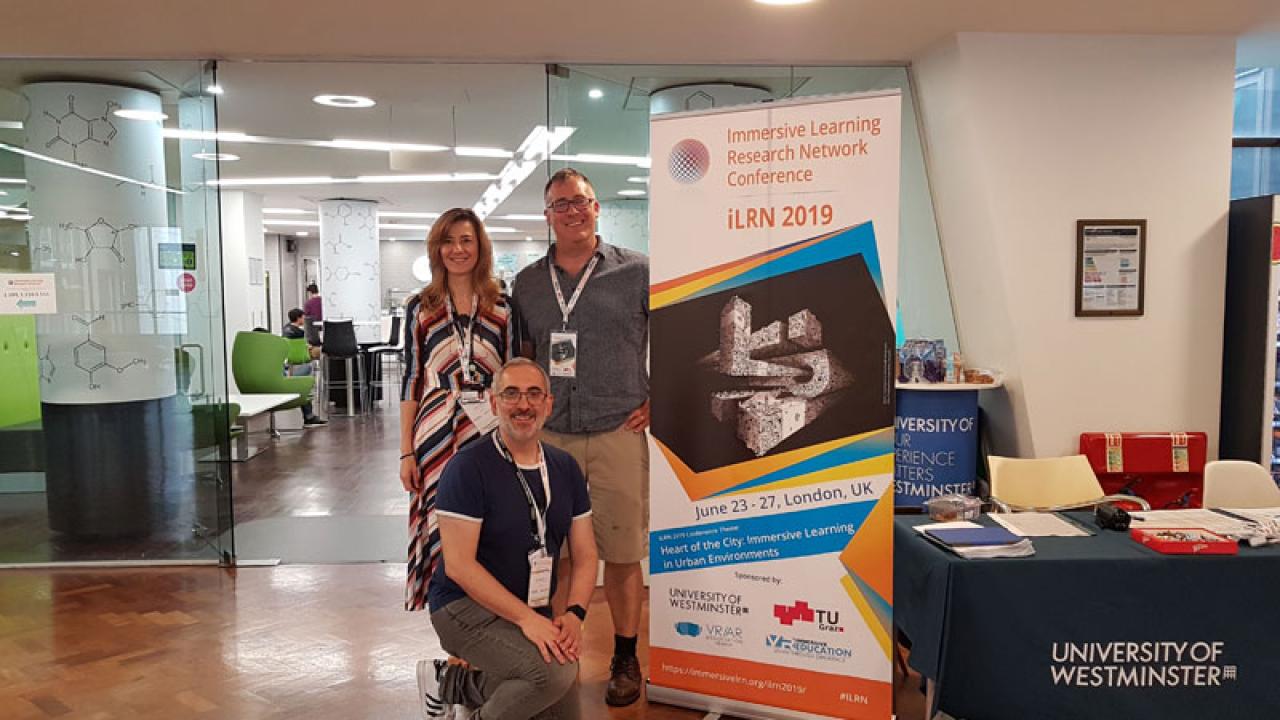
The fifth Annual International Conference of the Immersive Learning Research Network (iLRN) was hosted by the School of Computer Science and Engineering on 23-27 June at the University of Westminster.
iLRN consists of a multidisciplinary network of practitioners that brings together diverse voices from computer science, human factors, education and training community, as well as from business and industry. Across these interdisciplinary contexts, the Network aims to define the properties, conditions, procedures, states, measures and outcomes that combine to reliably create an effective immersive learning experience for learners. 
The theme of the conference this year was the ‘Heart of the City: Immersive Learning in Urban Environments’, chaired by Dr Daphne Economou and Markos Mentzelopoulos from the School of Computer Science and Engineering. Jeff Fergusson and Drew Cattanach also organised and facilitated two successful workshops titled ‘Introduction to Augmented Reality' and 'Narrative Designs using game engines’ respectively.
The event provided a number of academics with the opportunity to present their research outputs and enabled a number of undergraduate and postgraduate students to take part in the conference, helping out as volunteers and presenting their work to the audience.
Seven outstanding keynote and feature speakers presented inspiring talks and state of the art research output at the conference. They came from academia with defining roles in VR and AR in education, including Professor Mel Slater from the University of Barcelona and Dr Nigel Newbutt from the University of the West of England, as well as from the industry such as Facebook, British Telecoms, Promethean and Geo Immersive Reality. 
iLRN2019 offered a high quality academic as well as social programme, and attracted developers, educators, professionals, and researchers from 14 countries, all with the goal of collaborating to develop the scientific, technical, and applied potential of immersive learning. The event also attracted various companies that demonstrated pioneering solutions, the transformation of education and frontier technologies.
The University’s Vice-Chancellor Dr Peter Bonfield, also present at the event, emphasised the relevance of the conference to the University’s future thinking and strategy.  
Attendees commented extremely positively on the quality of the conference, the facilities of the University, the leadership and the professionalism of staff at all levels.
Dr Jonathon Richter, the Executive Director of iRNL conference, said about the event: “This was the best iLRN Conference yet. Thanks to the absolutely wonderful organizing team! I am so proud to work with these amazing scholars, visionaries, and fabulous friends. We would like to thank attendees, local organisers and volunteers at iLRN 2019 for making this such a successful conference. We had a fantastic time in London.”
The next iLRN conference will take place in the California Polytechnic State University in San Luis Obispo in June 2020. Academics from the University of Westminster have been assigned leading roles in the programme committee of iLRN 2020. 

Police hunt two men after gas released on Tube at Oxford Circus

CCTV images
Pic--Police have released images of two people they want to speak to/wp/ebc
Crime reporter(wp/ebc):::
Police are looking for two men after suspected CS gas was released during a fight on a London Underground train.
It happened at 09:13 BST on board a Victoria line Tube train at Oxford Circus in central London.
British Transport Police (BTP) said a number of people were treated at the scene by paramedics for coughing and shortness of breath.
The force has appealed for witnesses and released CCTV images of the two men they would like to speak to.
BTP added that other than the symptoms shown by the passengers, there were "no further concerns for their health".Passenger Michael Roberts was with his girlfriend on their way to Oxford when he said he saw two people "looking into the next carriage had seen some sort of a commotion".
"Then two guys stumbled into our carriage and all the people on our carriage moved naturally away from the door.
"That's when everybody realised we couldn't breathe properly."Passenger Michael Roberts was with his girlfriend on their way to Oxford when he said he saw two people "looking into the next carriage had seen some sort of a commotion".
"Then two guys stumbled into our carriage and all the people on our carriage moved naturally away from the door.
"That's when everybody realised we couldn't breathe properly."

Anti-Brexit protesters hold 'No to Boris' march

Balloon 
Political reporter(wp/ebc):::
protesters have taken to the streets of central London in a march against Brexit and Conservative Party leadership hopeful Boris Johnson.
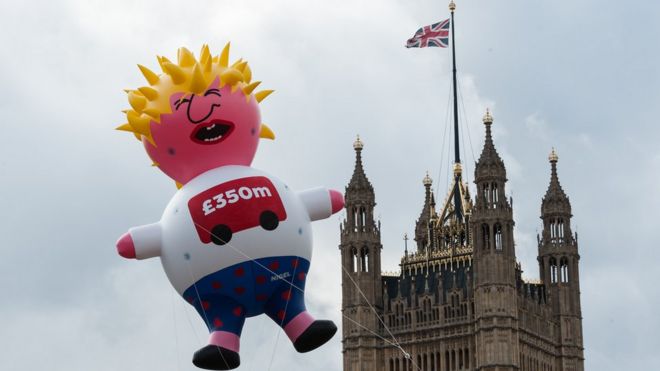
The pro-European March for Change is holding a "No to Boris, Yes to Europe" event, and includes a blimp depicting him.
Campaigners are asking for Mr Johnson to "stop the Brexit chaos".
Either he or Jeremy Hunt will be named as Theresa May's replacement as prime minister next week.
Former foreign secretary Mr Johnson, who has declined to comment on the march, is seen as the frontrunner in the contest.He said the UK would leave the European Union by 31 October "come what may" under his tenure, while Mr Hunt said he expected this to happen by Christmas.
Mr Johnson has claimed Brexit "done right" could "cement and intensify" the union between the UK nations.
The balloon depicting Mr Johnson has "£350m" emblazed on its front, symbolising the leave campaign's pledge of money towards the NHS during the 2016 referendum.
The March for Change organisers said: "We won't put up with a hard Brexit PM being imposed on the country and hurtling us towards the cliff edge."

'Paraglider' dies in 'tragic accident'

Camber Sands sea wall
Pic->The man was attempting to paraglide when he fell on to a wall/wp/ebc
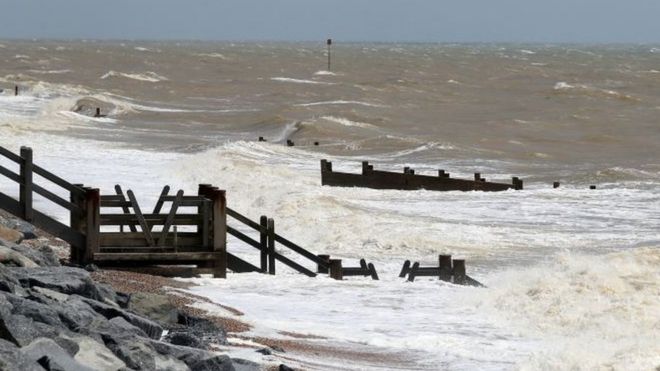
Staff  reporter(wp/ebc)::A man has died after falling on to a wall at a popular seaside location in the south east of England.
Sussex Police said the man was attempting to paraglide when he fell and sustained serious injuries at about 10:10 BST.
The man - who was not from the area - died at the scene. His next of kin have been informed.
The force said it was treating his death as a "tragic accident".
There had been some speculation the victim may have been a kite surfer.
An employee of the nearby Kitesurf Centre, who did not wish to be named, said: "It looks like an incident while they were setting up their kite. They weren't on the water."
He said weather conditions were good on Saturday, adding that it was "not massively windy".
A sign on a fence at the scene warns kite surfers more than "90% of accidents occur during launching".

British justice minister says he will resign from cabinet - The Sunday Times

La&Justice reporter(wp/reurters):::
British justice minister David Gauke said he will resign from the cabinet on Wednesday.
"Given that I've been in the cabinet since Theresa May came to power, I think the appropriate thing is for me to resign to her", Gauke said in a statement quoted in the Sunday Times newspaper