EDITORIAL:::Acid crime and world top country England---very recent we see countrywide as well capital London crime situation is rise dangerly..knif crime..street fight ..recently add so called acid crime..a world top law&justice enable country so strict for their people how come acid crime happen as like 3rd world country?In England how bad goes country image worldwide?how dare acid criminals are to do such kind of danger crime???last day in England elderly mother,her young daughter,one kids burn by acid criminal in street...nobody safe now..most of people are fear about acid burn them anytime if they goes to street..law for people,people not for law..if require any strict law to apply to protect danger acid crime as soon as possib lawmaker House of Lords should do this immedietly ..crime protection police should handale this matter strictly order from home ministry..we hope it will not happen again and England image down from 1st world..world idol country to 3rd world so called crime full unsafe country for its fellow citizens...
Wednesday, 10 April 2019


Friday, 5 April 2019
Lisa Nandy: Female MPs have become targets

Pic-Northern powerhouse: Lisa Nandy at Westminster (wp/es)
Political reporter(wp/es):::
Lisa Nandy was returning to her office in Portcullis House last Friday, weaving through the crowds of Leave protesters with their banners and flags, when she caught the attention of a group from The Red Lion pub.
“Oi!” they shouted, realising she was an MP. “Oi!” They moved unsteadily towards her, a picture of undisguised menace.
Close up, she could feel the heat of their anger. “‘F***ing traitor,’” they shouted in her face. She pauses. “There’s only one thing you do to traitors,” she says.
While she was being accosted, armed Westminster police at Derby Gate stood by. She doesn’t blame individual officers, who had “been given instructions not to intervene”, she says. “It’s the instructions that need to be reviewed.”
She managed to punch in her pin code and squeeze through the security barriers and into Parliament, but she was shaken. “It was really aggressive and threatening,” she says. “A horrible experience.” Those in charge don’t understand the threat faced by female MPs. “It isn’t taken seriously enough.”
Nandy’s point is this: in the intensifying Brexit debate there is a deliberate targeting of female MPs. “Most female MPs will say they have been struggling for the past year or so to get anyone in authority to do much or take much notice of what’s happening.”
The response to her complaint on Friday was typical. “They say they are logging it but it doesn’t meet the threshold for intervention. And move on.” What they are missing, she says, is the fact that “it’s part of a deliberate strategy to change the way we [women] vote.
“The people who are standing outside shouting ‘traitor’ are trying to change the outcome of votes. It’s not working, but it is threatening.”
Of course, the irony is that Nandy is trying to get Brexit across the line out of respect for her Leave-voting constituents in Wigan. She is one of a number of Labour MPs in Leave seats — including Caroline Flint and Gloria De Piero — whom Theresa May has been courting for support of her withdrawal agreement. As a result, Nandy is attacked by both extremes of the Brexit debate. She describes those running the People’s Vote campaign as “patronising and bullying”.
“The centre is shrinking. The longer this goes on, the more difficult it becomes to refind common ground. What’s happening in Parliament is a reflection of what’s happening in the country: attitudes hardening on both sides, the centre drowned out by extremes.”
Of particular concern are far-Right groups, which prey on the emotions bound up in the Brexit debate. Tommy Robinson’s army of Islamophobic nationalist thugs were out in force last Friday. But Nandy has noticed an uptick in support of groups such as the North West Infidels — a modern-day Combat 18. “This is the most active I’ve seen these groups since growing up in the Eighties. North West Infidels are trying to get a foothold in Wigan. They are having public meetings, recruiting, grooming people online. Their new strategy is threatening MPs.”
This week Labour’s Rosie Cooper spoke for the first time about the plot to kill her by a neo-Nazi. Cooper’s constituency, West Lancashire, is next door to Nandy’s. “I am a target,” says Nandy. “All Northern female Labour MPs are targets.” They mention her ethnicity (her father was born in Calcutta) “but they don’t make that the focus. They say you want to block Brexit.” Threats arrive by email. There are messages on her social media and by post. It’s for this reason too that Nandy was so enraged by Theresa May’s speech two weeks ago in which she pitched Parliament against the people. “At a time when MPs are carrying panic buttons and afraid for their physical safety, that was such a dangerous and irresponsible thing to do. It has cost her any remaining trust and goodwill.”
She says the public want politicians to take “collective blame” for the impasse. “At this moment of national fracture, the parties have become more tribal. [It] has left us paralysed, unable to see a way through.”
MPs such as Nick Boles have her respect for trying to do the right thing, at the probable price of never being elected to Parliament again. “Frankly, if it’s the last thing we all do, we need to get it right. This is not about who gets to have a top career later, this is about whether the country breaks apart.”
The dilemma for Nandy is that although she wants to honour Brexit, she is passionately opposed to no deal. “I am opposed to a second referendum and I abstained on the Kyle/Wilson proposal... We don’t have the option of ruling out options at this stage and we have to vote for anything we can live with, really. Now that needs to be balanced against the economic harm of leaving with no deal. The damage of no deal is so serious that I would vote to revoke Article 50.
“I’ve always been clear with my constituents, a third of them voted Remain. I’m their MP too and they have to have a stake in the country. I won’t allow us to go off down a hard-Brexit route that completely ignores their views and concerns. A second referendum would continue this ongoing war.”
Today we’re in Nandy’s bright office. There’s a pair of heels by her desk, ready to slip into, photos of her four-year-old son, a magnetic wall tacked with articles, a photograph of — naturally — Wigan pier.
Chuka Umunna’s office is opposite. She’s right, it does feel like school: “Like a public school,” she clarifies. Nandy was state-educated in Manchester, although not quite “the good working- class lass” Len McCluskey once introduced at a Labour event. Her father was a Marxist academic who set up the Campaign Against Racial Discrimination and ended up writing the 1976 Race Relations Act with Roy Jenkins. Her mother was a producer at Granada who worked on World in Action, and her grandfather was a Liberal MP.
She first came to Westminster as a researcher aged 21, working for a friend of Jeremy Corbyn. “Jeremy would amble into our office every now and again,” she says. He was always friendly to staff. “Which you notice about MPs when you’re not one. And he always had his own interests. He used to talk about his allotment, even then.”
She laughs. “The thing about Jeremy is that if he’s set himself on a course of action, he will stick to it. If his course of action is that he’s going to his allotment for an hour in the afternoon, then that is what he’s doing. He won’t be talked out of it. It must drive John [McDonnell] mad sometimes.”
She gets on with Corbyn, despite the fact that she helped run Owen Smith’s campaign when he challenged for the leadership. “I did it because he’s a friend.” She also wanted to end the infighting. Still, the Labour Party needs “hard work done on what we stand for, what sort of country we want to build”, she says. “There’s a view that somebody will come along and save us. It’s ideas and movements that change the world, not an individual with a bit of charisma.”
After her early stint in the Commons, Nandy spent 10 years in the voluntary sector (at Centrepoint). Returning to Parliament, she was chosen by Tessa Jowell to be her PPS. “There was absolutely no reason why she should have fished an awkward Left-winger off the back benches. But she gave me the chance to see how a major national project was built from the inside. She was generous and non-tribal.”
Jowell, who called her “darling”, echoed Nandy’s mother’s view that it was important to listen to “other traditions”. For instance: “I’m a socialist and a liberal. But there’s something to be learned from one-nation conservatism.”
Nandy’s parents split when she was seven. She watched her mum battling to protect her from the prevailing prejudices of the day about “single mums”. “We were always the smartest turned-out at school. We had to demonstrate that we were a decent family. She discovered her mother would put her and her sister to bed before returning to work while they were left with a childminder.
Nandy was shadow energy minister when her baby was three months old. “Jan Royall, who was our leader in the Lords, had a big office and at night she would turn it into a crèche so Catherine McKinnell and I could park our babies there to sleep.”
After the referendum she set up a think-tank to evaluate why towns like hers have remained relatively depressed compared to cities. She says it is possible for communities to heal. “I voted Remain,” she laughs. “Most of my street voted Leave. We are not trying to thump each other. My neighbour still puts my bins out when I’m down here.”
In the background, we notice Yvette Cooper on the telly. Nandy remarks: “The people who are still trying to find a way through this are important because a lot of people have just given up. This place is designed to prevent change and preserve the status quo. It’s not designed for consensus or negotiation or compromise. It’s designed, with social media and cameras in the chamber, for protest rather than politics. The Brexit impasse has brought to the fore how much it needs to change."
Woman and man die in Kirby Muxloe house fire
staff reporter(wp/bbc):::
A woman and a man have died in a house fire.
Leicestershire Police said it was called to the house in Church Road, Kirby Muxloe, Leicestershire, at 03:30 BST.
The pair, who have not yet been formally identified, were pronounced dead at the scene.
Leicestershire Fire and Rescue Service said the blaze was under control. An investigation into the fire is ongoing and a cordon remains at the scene.
A fire investigation dogs vehicle could be seen parked on an adjacent road and an aerial ladder was used to tackle the flames.
Gas supplier Cadent also had vehicles near the property.
Sally Challen bailed after denying murdering husband
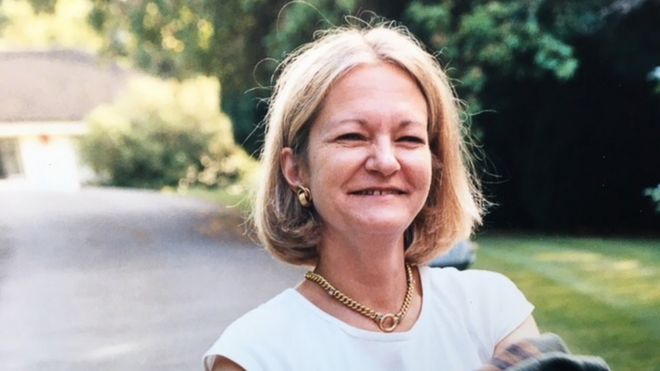
Pic-Sally Challen denies murdering her husband Richard in 2010
Crime reporter(wp/bbc):::
A woman whose sons campaigned against her conviction for murdering her husband has been bailed ahead of a fresh trial.
A woman whose sons campaigned against her conviction for murdering her husband has been bailed ahead of a fresh trial.
Sally Challen, 65, was found guilty of murdering 61-year-old Richard in a hammer attack in August 2010 and jailed for life in 2011.
But the conviction was quashed by the Court of Appeal in February.
Appearing at the Old Bailey via video-link earlier, Mrs Challen, of Claygate in Surrey, denied murder.
Mr Justice Edis said Mrs Challen, who wept in court as she was granted bail, should be released from custody from midday on Saturday.
He set a further hearing for 7 June and a trial date for 1 July "if necessary".
The appeal followed a campaign by her sons David, 31, and James, 35.
Speaking outside court, David said the family were looking forward to "being together again after so long".
He said: "We are overjoyed that bail has been granted for our mother and she will be now released back to us. Our mother now rejoins our family."
Mrs Challen's brother Chris Jenney added: "The family are all supporting Sally. We have done from day one. Our strength's built and will build even further."
During the two-day appeal hearing in February, the court heard evidence relating to Mrs Challen's state of mind at the time of the killing and the issue of "coercive control".
Coercive control describes a pattern of behaviour by an abuser to harm, punish or frighten their victim and became a criminal offence in England and Wales in December 2015.
The murder conviction was overturned by three judges who said the evidence of a psychiatrist, that Mrs Challen was suffering from two mental disorders at the time of the killing, was not available at the time of her trial and undermined the safety of her conviction.
Lawyers for Mrs Challen, who has never denied killing her husband, asked for the murder conviction to be substituted to manslaughter but the panel of judges refused and ordered a retrial.
Speaking outside the Royal Courts of Justice after the conviction was quashed, David said: "The abuse our mother suffered, we felt, was never recognised properly and her mental conditions were not taken into account."
Birmingham Pub bombings: Victims were unlawfully killed
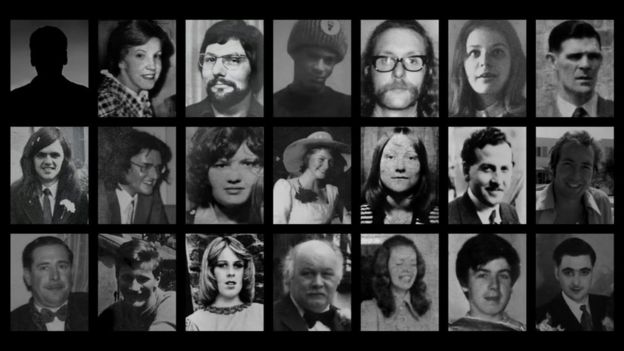
Pic-The victims of the 1974 bombings were aged between 16 and 51
Crime reporter(wp/bbc):::
An IRA call came too late to prevent the deaths of 21 people in the 1974 Birmingham pub bombings, a jury found.
The blasts at the Mulberry Bush and Tavern in the Town pubs on the night of 21 November also injured 220 people.
Inquest jurors concluded there were no errors in the way police responded to the warning call and their actions did not contribute to the loss of life.
Families of the victims have called on police to "bring to justice" those behind the bombings.
Julie Hambleton, whose sister Maxine died in the bombings, said: "West Midlands Police have always told us when they get new evidence they will act on it, well here you go, you have the new evidence and I'm sure there is more to be had and more to be found."
She did not describe the inquest's conclusion of unlawful killing as "vindication" but "that our loved ones have now been officially put on to the books as being officially murdered, and as such that gives us hope to move forward to get those who are still alive caught and for justice to be had".
Coroner Sir Peter Thornton QC said the bombings were "etched in the history" of the city.
Jurors at Birmingham Civil Justice Centre found the warning call was not adequate for the purposes of ensuring that lives were not lost in the explosions.
The call from an IRA member was made to the Birmingham Post and Mail at 20:11. The first bomb weighing between 25lb-30lb (11kg-14kg) detonated in the Mulberry Bush seven minutes later.
The second bomb weighing 30lb (14kg) exploded in the nearby Tavern in the Town two minutes later.
A third bomb was planted near the Barclays Bank on Hagley Road but failed to properly detonate that night.
The jury at the six-week hearing said there was "not sufficient evidence" of any failings, errors or omissions in West Midlands Police's response to the bomb warning call, or in regards to two alleged tip-offs to the force giving advanced warning of the blasts.
Following the conclusions, Sir Peter said the "dreadful events will never be forgotten".
"It would be not right to leave the inquest without paying tribute to those who helped that dreadful night," he added.
"We always expect our emergency services, particularly the police and fire fighters to be there for us at the time of disaster and they were."
The coroner went on to thank the members of the public who "just did the right thing and helped as best they could".
"These were the people of Birmingham shown at their best; brave generous, selfless.
"A genuinely positive side of humanity in contrast to the devastation and destruction all around them."
Leslie Thomas QC, representing 10 of the bereaved families, added thanks on their behalf to those who helped on the night of the attacks.
"We just hope, in light of the jury's unequivocal finding that the IRA murdered 21 innocent people, that the West Midlands Police will now redouble their efforts in terms of those bombers who may still be alive to bring them to justice," he said.
The inquests came about after years of campaigning by families for a full account into what happened that night.
A botched police investigation led to the 1975 jailing of the Birmingham Six, but their convictions were quashed by the Court of Appeal in 1991.
There was a dramatic twist towards the end of evidence at the inquest, when a former IRA member named the four the men he claimed were involved in the bombings as Seamus McLoughlin, Mick Murray, Michael Hayes and James Francis Gavin.
The man, identified in court only as "Witness O", said he had been authorised to give those names by the current head of the IRA in Dublin.
Man charged over string of north London stabbings
Crime reporter,London(wp/reuter):::
A man has been charged with five counts of attempted murder following a series of stabbings in north London which have heightened public concern about rising knife crime in Britain.
Jason Kakaire, 29, will appear at Highbury Corner Magistrates’ Court later on Friday, police said.
The attacks began on Saturday night when four people were stabbed overnight. A fifth victim was found with knife wounds early on Tuesday morning.
The latest attack came a day after Prime Minister Theresa May hosted a security summit at her Downing Street office to discuss ways of stemming the rise in knife crime.
Last year, there were 285 fatal stabbings in England and Wales, the highest number since records began more than 70 years ago. At least 48 people in Britain have been stabbed to death since the start of 2019.
After the north London attacks, a woman remains in hospital with life-changing injuries, while two men are in stable condition. The other two victims have been discharged from hospital.
UK house price growth cools in early 2019, outlook subdued: Halifax
Staff reporter(wp/reuters):::
British house price growth cooled in the first three months of 2019 in annual terms and the outlook is likely to remain subdued, given Brexit uncertainty and high property prices, mortgage lender Halifax said on Friday.
Compared with the same period of last year, prices rose by 2.6 percent, slower than a rise of 2.8 percent in the three months to February.
A Reuters poll of economists had pointed to an annual rise of 2.3 percent for the first quarter.
Last week, data from rival mortgage lender Nationwide showed house prices picked up a bit of speed.
But Britain’s housing market remains weak, especially in London, as Prime Minister Theresa May struggles to find a way to leave the European Union with a transition deal to cushion the shock to the economy.
Shortly before the Brexit referendum in 2016, house prices were rising by about 10 percent a year, according to Halifax.
The lender said that prices in March, in monthly terms, fell by 1.6 percent after jumping by 6.0 percent in February.
Halifax’s index has tended to be more volatile than other measures of house prices of late.
(This story has been refilled to correct headline and story to show annual house price growth slowed to 2.6 percent, rather than accelerated to 3.2 percent, after data provider Halifax published erroneous figures)
Subscribe to:
Posts (Atom)